
Subtotal R0,00

Western Cape/ 11 January 2026, 06:48am/ GoodWill Mathebula
By GoodWill Mathebula: Before any live-fire drills or radio calls crackle across the water, Simon’s Town has already begun the kind of work that rarely makes headlines: forklifts shifting pallets, tenders ferrying sailors, fuel deliveries timed to the minute, and local traffic rerouted around tightened security lines.
In a port where the Indian Ocean meets the Atlantic, the first act of a multinational naval exercise is logistical—until the flags on the sterns make it political.
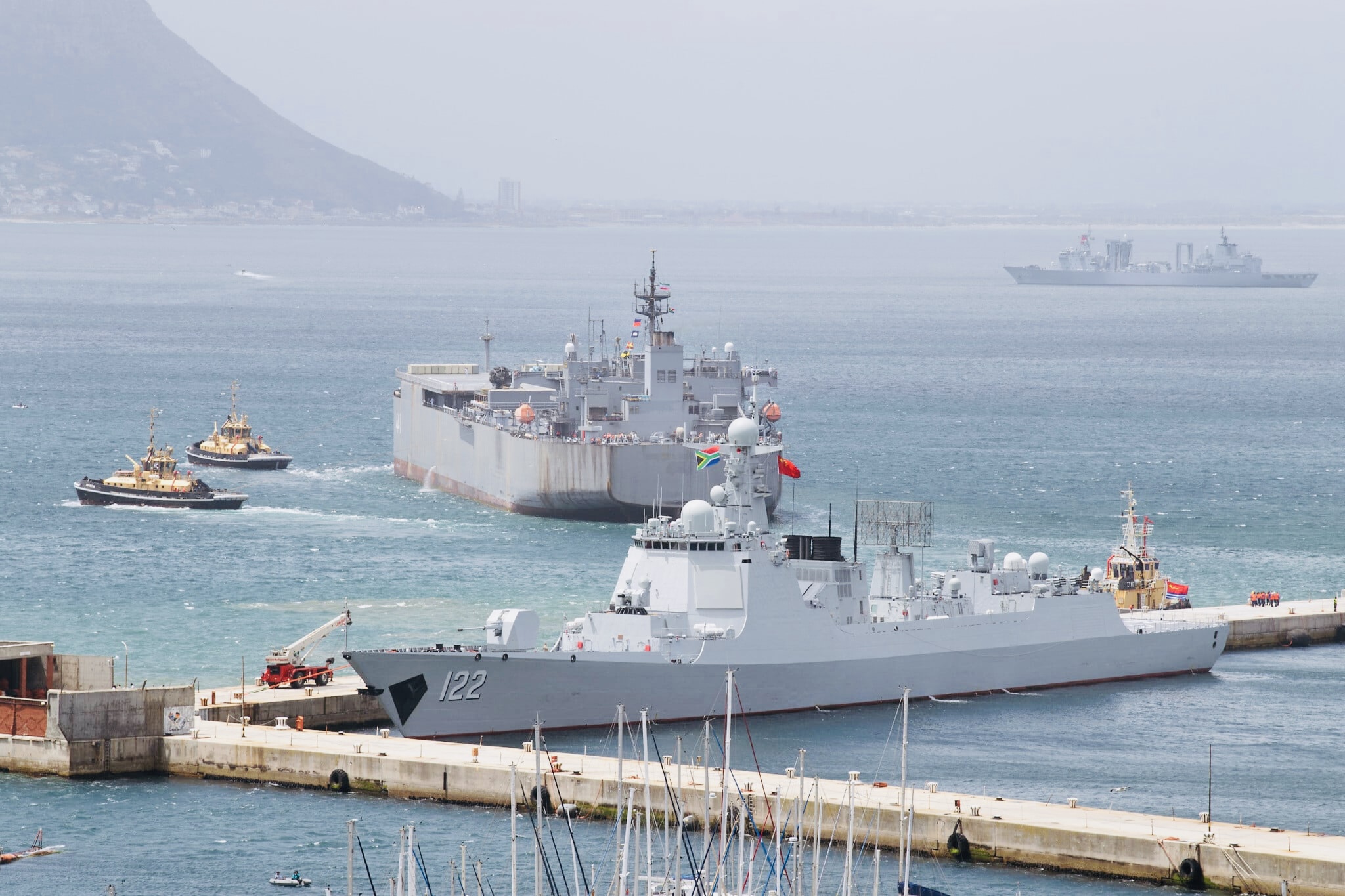
That politics arrived clearly this week as Chinese and Iranian warships anchored off South Africa’s main naval base on Thursday, ahead of the January 9–16 exercise officially titled “Will for Peace.”
South African navy officials said Russian vessels were also expected, turning False Bay into an unusually scrutinised waterfront—one where every gangway and every supply truck is interpreted as a signal.
Officials insist the exercise is framed by practical maritime needs rather than grand strategy. The South African defence force said in December the drill was focused on the “safety of shipping and maritime economic activities” and meant to “deepen cooperation in support of peaceful maritime security initiatives,” emphasising seamanship, coordination and common operating procedures.
Separately, South Africa’s defence force said the event will allow the navies “to exchange best practices and improve joint operational capabilities, which contributes to the safety of shipping routes and overall regional maritime stability”.
China echoed that operational language as the ships gathered offshore. China’s defence ministry said in a statement on Friday that the exercises, set to kick off with an opening ceremony on Saturday, are “joint operations to safeguard vital shipping lanes and economic activities”.
Yet the guest list guarantees the exercise will be read far beyond naval circles. South Africa is hosting a drill it has described as involving BRICS partners at a moment when President Donald Trump has accused countries in the BRICS group of emerging nations of “anti-American” policies.
It was not immediately clear if other countries from the BRICS group – which also includes Brazil, India and the United Arab Emirates, among others – would take part in the drills.
A spokesperson for the South African armed forces said he wasn’t yet able to confirm all the countries participating in the drills, which are due to run until next Friday.
The scrutiny is sharpened by South Africa’s already tense relationship with Washington. South Africa has drawn US criticism for its close ties with Russia and a range of other policies, including its decision to bring a genocide case against Israel at the International Court of Justice over the Gaza war.
In that context, even routine port movements—ships moving into and out of harbour, a helicopter on the pad, a closed-off stretch of roadway—become part of a larger narrative that local organisers cannot fully control.
Chinese, Russian and Iranian ships were seen moving into and out of the harbour that serves South Africa’s top naval base in Simon’s Town, south of Cape Town, where the Indian Ocean meets the Atlantic Ocean.
For residents and visitors along the peninsula, the sight is striking but familiar: navies have long used the Cape sea route as both a resupply point and a training space. This week, however, curiosity carries an edge, as international tensions provide an uninvited soundtrack.
Those tensions have been thrown into high relief by events far from South Africa’s coast. The exercises come amid heightened tensions after the US military attacked the Venezuelan capital, Caracas, on Saturday and abducted the country’s president, Nicolas Maduro.
The Trump administration has also been seizing Venezuela-linked oil tankers in international waters, including a Russian-flagged vessel in the North Atlantic that Washington said had violated US sanctions.
The seizure drew rebuke from Moscow, with the Russian authorities describing the incident as a violation of international maritime law.
South African officials have pushed back against suggestions the timing is a message. Asked about the timing of the event, South Africa’s Deputy Defence Minister Bantu Holomisa said it was planned long before these tensions we are witnessing today.
He warned against reading South Africa’s hosting role as alignment in another country’s dispute: “Let us not press panic buttons because the USA has got a problem with countries,” Holomisa said. “Those are not our enemies.”
Still, the exercise lands on politically sensitive ground at home as well. The backdrop includes earlier controversy over similar drills. South Africa’s military was criticised for hosting naval exercises with Russia and China in 2023 that coincided with the one-year anniversary of the Kremlin’s invasion of Ukraine.
This time, criticism is also coming from within the governing coalition’s orbit. South Africa’s willingness to host Russian and Iranian warships has also been criticised inside the country, with the Democratic Alliance saying it was opposed. “Calling these drills ‘BRICS cooperation’ is a political trick to soften what is really happening: Government is choosing closer military ties with rogue and sanctioned states such as Russia and Iran,” the party said.
For now, the immediate scene remains more procedural than theatrical: crew lists checked at the gate, maritime safety notices issued, and patrols keeping curious onlookers at a distance.
But with Chinese and Iranian vessels already in place and Russian ships expected, the “Will for Peace” exercise is unfolding under a dual spotlight—one trained on the technical goals of maritime cooperation, and another on what the gathering of these particular navies might mean in a world where even a routine port call can be interpreted as a statement.







