Subtotal R0,00

News/29 October 2025, 15:54pm/Gomolemo Winkel
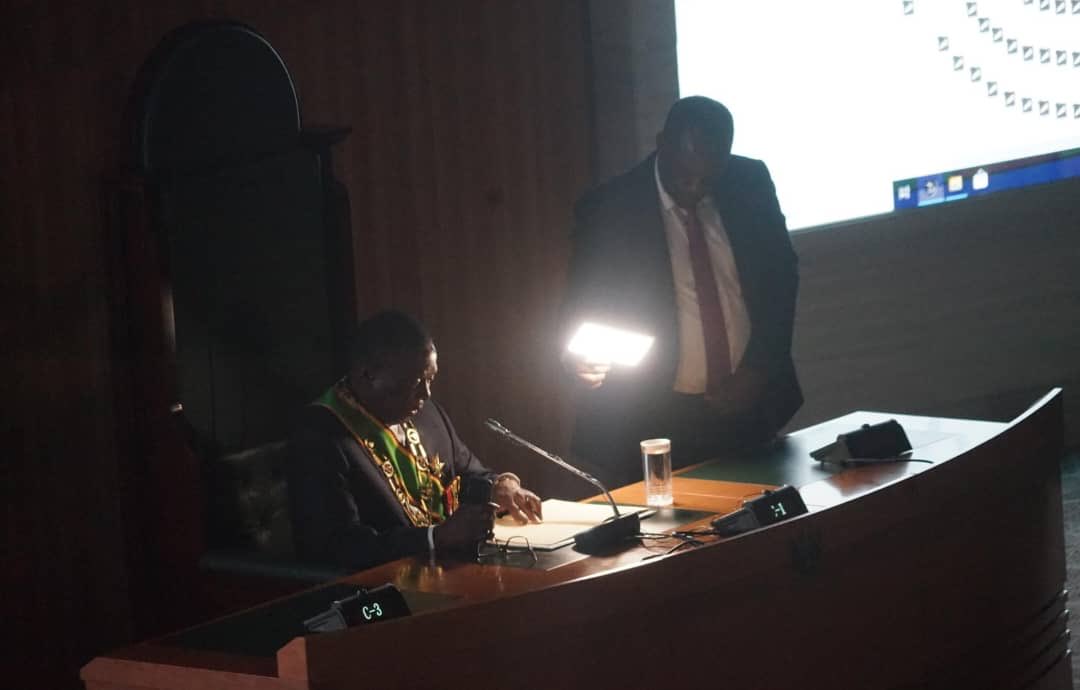
The blackout plunged Parliament into darkness on Tuesday, 28 October 2025. It forced President Mnangagwa to continue his speech under the glow of mobile phone torches, exposing the country’s ongoing electricity challenges and sparking widespread outrage: Image supplied.
By Gomolemo Winkel: In a dramatic response to a humiliating power failure during President Emmerson Mnangagwa’s State of the Nation Address (SONA), the Managing Director of the Zimbabwe Electricity Transmission and Distribution Company (ZETDC), Abel Gurupira, has been dismissed from his position with immediate effect.
The blackout, which plunged Parliament into darkness on Tuesday, 28 October 2025, forced President Mnangagwa to continue his speech under the glow of mobile phone torches, exposing the country’s ongoing electricity challenges and sparking widespread outrage.
According to reports, Energy Minister July Moyo ordered Gurupira’s removal shortly after the incident, signaling the government’s growing frustration over persistent power shortages that have crippled the nation for years.
The President’s annual SONA had been underway in Parliament when the lights suddenly went out, leaving lawmakers and guests in complete darkness. Witnesses described the moment as chaotic, with aides scrambling to provide emergency lighting as technicians rushed to restore power.
Videos and photos of the incident, showing Mnangagwa continuing his address under torchlight went viral across social media, with hashtags like #ZimBlackout and #SONAEmbarrassment trending throughout the night.
The blackout disrupted the live broadcast and drew immediate criticism from opposition parties, who called it an “international embarrassment.” Citizens also voiced anger at what they viewed as a symbol of deeper failures in government and infrastructure management. “This was supposed to be the most important speech of the year and even Parliament is not spared from load-shedding,” quipped one opposition spokesperson.
Sources close to government confirmed that Energy Minister July Moyo issued the dismissal directive within hours of the blackout. Gurupira, who had been leading ZETDC in efforts to stabilize the grid, was informed that his services were terminated with immediate effect.
Although no detailed explanation has been released, the sacking is widely seen as fallout from the embarrassing incident that overshadowed the President’s national address.
However, critics, argue that Gurupira’s dismissal may be a scapegoating move rather than a genuine fix to Zimbabwe’s deep-seated energy problems. Others view it as a necessary signal that the government is finally demanding accountability.
Zimbabwe’s power crisis is not new. Aging infrastructure at Hwange Power Station, low water levels at Kariba Dam, and chronic foreign currency shortages have led to daily load-shedding of up to 18 hours in some areas.
The country currently produces about 1,200 megawatts (MW) against a demand of 2,200 MW, forcing authorities to rely on electricity imports from South Africa and Mozambique, supplies that are often interrupted due to unpaid bills.
Recent efforts, such as the expansion of Hwange Units 7 and 8, were expected to ease the shortages, but persistent breakdowns and maintenance delays have limited the impact. Renewable energy projects, including proposed solar farms in Gwanda, have also been slowed by funding challenges.
The blackout and subsequent dismissal of Gurupira have reignited national debate over accountability and reform in the power sector. Business leaders expressed concern over the economic impact of unreliable energy supply, estimating millions in productivity losses each year.
The Confederation of Zimbabwe Industries has called for urgent investment in alternative energy sources and modernization of the national grid.
Meanwhile, citizens flooded social media with frustration and humor in equal measure. Memes of the President’s “torchlight SONA” circulated widely, with many calling the moment “a metaphor for Zimbabwe’s leadership in the dark.”
President Mnangagwa, before the blackout disrupted his address, had outlined plans to strengthen the economy and stabilize public utilities, including the energy sector. However, the timing of the power failure overshadowed those promises, exposing the gap between official rhetoric and on-the-ground reality.
Analysts suggest that Gurupira’s removal could be the start of a broader reshuffle in the energy portfolio, as government seeks to restore confidence in its ability to manage essential services.
Energy experts are urging authorities to focus on long-term sustainability, including private sector participation, regional energy cooperation, and investment in renewable sources.