Subtotal R0,00

News/27 October 2025, 15:05pm/ Ayanda Shezi
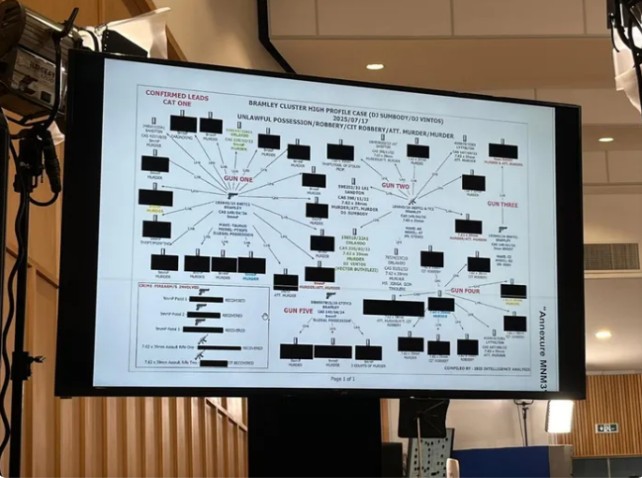
Graphic showing firearms linked to the murders of Armand Swart, Oupa “DJ Sumbody” Sefoka, and Hector “DJ Vintos” Buthelezi, tied to over 20 other pending cases. Photo: Image supplied
By Ayanda Shezi: A senior police forensic expert has revealed alarming details about the mounting backlog of criminal cases awaiting ballistic analysis, with over 41,000 investigations stalled due to severe capacity constraints within the South African Police Service (SAPS).
Testifying before the Madlanga Commission on Monday, SAPS ballistics expert Brigadier Mishak Mkhabela described a department struggling to keep pace with the volume of evidence flooding its laboratories. He said the backlog — now at 41,846 cases — reflects a national crisis undermining the justice system’s ability to prosecute violent crimes.
“We have repurposed a museum, and even that is full,” Mkhabela told the commission, explaining that the SAPS had resorted to unconventional means to store thousands of seized firearms awaiting examination. “In our strong safe, at any given point, I have more than 29,000 firearms, each linked to a killing. We only have 42 analysts.”
According to Mkhabela’s testimony, 29,385 of the pending cases stem from the national office alone, with 10,643 still unresolved in 2025. Provincial figures show the Western Cape leading with 5,196 cases, followed by KwaZulu-Natal with 3,710 and the Eastern Cape with 2,174 — illustrating a countrywide pattern of backlogs across forensic units.
Mkhabela presented evidence showing that some firearms recovered in high-profile killings — including those of musician Oupa “DJ Sumbody” Sefoka, Armand Swart, and Hector “DJ Vintos” Buthelezi — were linked to more than 20 other unsolved cases. The delays in confirming ballistic matches have not only stalled investigations but also hindered the ability of prosecutors to bring perpetrators to court.
He admitted that the chronic shortage of skilled personnel, outdated systems, and limited laboratory capacity have left investigators overwhelmed. “We’re working under pressure from courts that continue to issue warrants of arrest while the evidence remains unprocessed,” Mkhabela said.
The commission heard that each ballistic analysis requires time-intensive testing and verification, but with only a handful of analysts available, progress has slowed to a crawl. The ballooning backlog has resulted in lengthy delays for families seeking justice, while suspects in major crimes often remain at large.
The revelations have amplified growing concern about SAPS’s forensic infrastructure — a crucial pillar in the criminal justice process. The Madlanga Commission, which is probing alleged inefficiencies and misconduct within law enforcement, is expected to use Mkhabela’s testimony to assess whether systemic reforms are needed to address the backlog and restore public trust in the police’s ability to solve violent crimes.