
Subtotal R0,00


Disclaimer: The opinions expressed within the following content are solely the authors and do not reflect the opinions and beliefs of the Insider Chronicle or its affiliates.
Opinion Piece/ 13 January 2026, 11:09am/ Lebona Lekoena
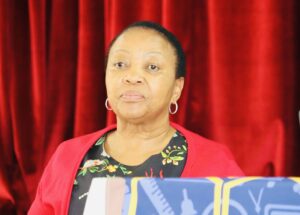
Dr Mamiki Maboya became the Free State MEC for Education: Image Supplied
By Lebona Lekoena: The Free State’s move from first to second place in the national matric rankings in 2025 has triggered an unusually sharp reaction, largely because the province had held first position for eight consecutive years.
In an environment where education outcomes are often reduced to a single headline—“who came first?”—a change in rank can easily be framed as a sign that something is going wrong.
Since Dr Mamiki Maboya became the Free State MEC for Education in 2024, the ranking shift has also been used by some to imply that the province’s performance has declined under her leadership.
A more sober reading of the data suggests a different conclusion. It does not deny that the Free State has challenges, nor does it claim that ranking is irrelevant. It simply insists that performance must be evaluated using what the numbers actually show, and with an understanding of how education systems work.
Consider the pass rates that have been widely cited: in 2023 the Free State achieved 89.03% and ranked first. In 2024 it recorded 91.0% and again ranked first. In 2025 it achieved 89.33% and ranked second, behind KwaZulu-Natal, which obtained 90.6%.
These figures matter because they show that the province’s 2025 percentage did not drop dramatically. In fact, the 2025 pass rate is slightly higher than the 2023 figure—yet in 2023 the Free State was first.
The most striking change between 2024 and 2025 is therefore not a collapse in pass rate, but a change in relative position because another province performed better in that year.
This distinction is often missed in public commentary. Rankings are comparative. A province can maintain a strong pass rate and still shift down a place if another province improves more sharply.
The reverse is also true: a province can keep its ranking even if its own performance weakens, provided others weaken more. For that reason, rank should be treated as an indicator of competitive position, not as a direct and standalone measure of decline or progress.
On that basis, the claim that the Free State “dropped” in 2025 in a way that indicates serious deterioration is difficult to sustain from the percentages alone. The Free State’s 89.33% remains among the highest in the country.
The gap behind the leading province—about 1.27 percentage points—is meaningful, but it is not evidence of systemic breakdown. It is evidence that top performance is contested and that small margins now determine who sits at number one.
This is where Dr Maboya’s role should be considered carefully. She assumed office in 2024, but matric outcomes are not produced in a single year.
A matric cohort reflects accumulated learning and teaching over many years: the quality of foundational literacy and numeracy, subject choices and support in Grades 10–12, teacher availability and competence, school leadership, the stability of district support, and broader social and economic conditions that shape learner readiness.
Any attempt positive or negative to attribute 2025 results solely to a single office bearer risks oversimplification.
Still, it is reasonable to ask what can be inferred from her first full year as MEC. The most credible inference is that the province sustained high performance during a period when public expectations are particularly intense. Maintaining a strong pass rate through leadership transition is not automatic.
Education departments can be destabilised by changes in priorities, turnover in senior management, inconsistent district oversight, or administrative disruptions that pull attention away from teaching and learning. When systems are fragile, the impact can be immediate. The Free State’s continued high performance suggests that stability was preserved rather than undermined.
That does not mean all credit belongs to the current MEC. The Free State’s long run of top finishes indicates that strong systems and practices were in place before 2024. But it also does not follow that the MEC’s contribution is negligible.
Keeping a high-performing system focused requires coordination, discipline, clear expectations, and the ability to support schools without creating constant disruption. In that sense, continuity can be a strength in leadership, especially in education where constant restructuring often produces unintended harm.
The conversation should also move beyond the pass rate and ranking as the only measures that matter. A province can hold a high pass rate while still facing serious issues: uneven performance between districts, weak outcomes in critical subjects, or persistent challenges in under-resourced schools.
Conversely, a stable pass rate can still represent important progress if it coincides with gains in quality indicators such as bachelor-level passes or improved results in gateway subjects. Without these additional details, sweeping conclusions—either celebratory or alarmist—are not well grounded.
Yet even within the limited information under discussion, one point is clear: the narrative of a steep decline does not align with the figures. From 2023 to 2025, the Free State remained in the high-80s to low-90s range.
The province’s 2025 pass rate is not far from its recent performance pattern and remains among the best nationally. If the public debate is to be credible, it should acknowledge that reality, even while insisting on deeper accountability about quality, equity, and subject-level outcomes.
Resource constraints are another part of this assessment that should be treated seriously, but not casually. “Minimal resources” can become a rhetorical shield in government, used to excuse poor planning or weak implementation.
At the same time, the constraints facing provincial education are real: infrastructure backlogs, rural transport challenges, staffing gaps in scarce-skill subjects, uneven access to study support at home, and the ongoing effects of socio-economic hardship.
Managing within these limits requires prioritisation and execution—ensuring materials and timetables are in place, teacher posts are filled where possible, district support is consistent, and learners are given structured academic assistance.
If Dr Maboya’s administration has managed to keep results high in that context, it suggests functional governance rather than failure. Again, this is not a claim that everything is solved; it is a recognition that sustained outcomes in a constrained environment are not accidental.
The more pressing question for 2026 and beyond is what the province does with the 2025 outcome.
A mature response would not be to chase first place for its own sake, but to identify exactly where the marginal losses occurred: which districts underperformed relative to previous years, which subjects pulled down overall achievement, whether attendance and retention shifted, and whether targeted learner support reached the schools that needed it most.
That sort of diagnosis is more useful than general arguments about whether the MEC is “good” or “bad.”
It is also worth noting that strong performance can sometimes conceal vulnerability.
When a province sits at the top for many years, the system can become reliant on a limited set of high-performing schools or districts. If performance dips in those nodes even slightly the province can lose its top ranking quickly.
That does not necessarily reflect province-wide decline; it can reflect how concentrated excellence may be.
Addressing that risk requires broadening strength across more schools, especially those serving poorer communities. This is where leadership matters: building depth rather than relying on a familiar set of strong performers.
Taking everything into account, the most balanced view is that the Free State’s 2025 result should be seen as continued strong performance rather than a crisis. The province did not retain first position, but its percentage did not collapse and remains close to recent levels.
The ranking shift appears primarily linked to improvement elsewhere, especially KwaZulu-Natal’s 90.6%. Within that reality, Dr Mamiki Maboya’s first full year as MEC aligns more with stability and continuity than with decline.
The public interest is best served by holding the department to high standards without distorting the evidence.
The Free State can aim to regain first place, but the more important goal is to sustain quality, strengthen weaker districts and subjects, and ensure that strong outcomes are shared across communities.
If those priorities guide the work going forward, the province’s education story will be measured not only by where it ranks, but by how well it equips learners for further study, work, and life.
Lebona Lekoena is the Chairperson of the Free State Publishers and Editors Forum. He writes in his personal capacity.







