
Subtotal R0,00

International/ 05 January 2026, 14:26pm/ GoodWill Mathebula
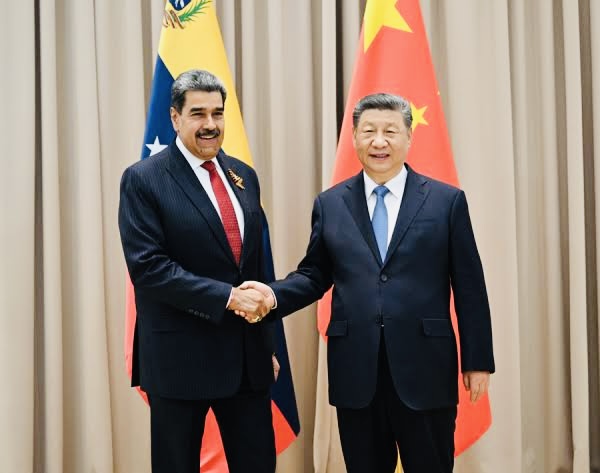
Venezuelan President Nicolas Maduro and Xi Jinping President of the People’s Republic of China: Image Supplied
By GoodWill Mathebula: The sudden U.S. military operation in Venezuela has done more than remove a president from his seat: it has jolted a sprawling web of Global South partnerships that China has spent years building—and exposed how little room Beijing has to respond when Washington uses force in the Western Hemisphere.
After “massive military strikes” hit Caracas and other regions and Venezuelan President Nicolas Maduro and his wife, Cilia Flores, were taken out of the country, China shifted the spotlight from Venezuela’s internal crisis to what it sees as a precedent-setting intervention.
Beijing demanded Washington “immediately release” Maduro, said the pair’s safety must be prioritised, urged the U.S. to “stop toppling the government of Venezuela”, and called the action a “clear violation of international law“.
Those lines, delivered in China’s second statement since Saturday, were amplified by an earlier broadside condemning U.S. “hegemonic acts” and “blatant use of force” and urging adherence to the United Nations charter.
But the bigger message was strategic: Beijing is signalling that Latin America is no longer a peripheral theatre—it is tied directly to China’s credibility as a champion of sovereignty in the “Global South strategy”.
That framing helps explain why the episode has resonated in Beijing beyond Venezuela’s oil. China is Venezuela’s largest buyer of oil, according to Andy Mok, a senior research fellow at the Center for China and Globalisation, though Venezuelan crude still makes up only 4–5 percent of China’s total imports.
The larger stake is political and commercial momentum across the region—ports, infrastructure, telecoms, finance—investments that depend on stable governments and predictable transitions.
Mok told Al Jazeera that a Chinese delegation met Venezuelan officials just hours before the U.S. action, and said Beijing was “not surprised” by Washington’s move given American strategic and economic interests. What did stand out, he said, was how the operation was carried out, because it may “represent the long-term US strategy in the region”. Mok warned that a return to a Monroe Doctrine-style approach would sharpen rivalry with China, since Latin America is a “pillar of China’s Global South strategy”.
Yet the crisis is also highlighting a hard constraint: China’s likely response ceiling. Shaun Rein, founder of the China Market Research Group, said Beijing is alarmed but limited to diplomacy. “I think China has issued a very strong condemnation of the United States, and they’re working with other Latin American and Caribbean countries to say this isn’t right,” he told Al Jazeera.
But, he added, “There’s not a lot of things that China can do. Frankly, it doesn’t have the military power. It only has two military bases outside of China, while America has 800,” stressing that, “historically, China is not warlike”. As a result, Rein said, “China is just going to make proclamations criticising the United States’ actions, but they’re not going to push back with military action, and they’re probably not going to push back with economic sanctions.”
International reaction has underlined the new fault line. Left-leaning leaders in Brazil, Colombia, Chile and Mexico have largely denounced Maduro’s ouster, while right-wing governments from Argentina to Ecuador have largely welcomed it.
North Korea denounced the US. strikes on Venezuela, calling them “the most serious form of encroachment of sovereignty,” KCNA reported, adding: “The incident is another example that clearly confirms once again the rogue and brutal nature of the United States,” citing a Foreign Ministry spokesperson.
South Korea urged talks: “Our government urges all involved parties to make utmost efforts toward easing regional tensions. We hope for a quick stabilisation of the situation via dialogue, ensuring democracy is restored, and the will of the Venezuelan people is honoured,” its Foreign Ministry said.
Australian Prime Minister Anthony Albanese backed a “peaceful, democratic transition” while insisting international law be respected, saying Canberra was “monitoring developments”.
Venezuela, increasingly isolated since Maduro’s contested 2024 election, has leaned harder on a small circle of partners. China and Russia continue to maintain strong economic and strategic ties, and alliances have grown with Iran over shared opposition to U.S. policy. With Maduro now in U.S. custody, that network is being stress-tested—along with Beijing’s promise that its Global South partnerships offer a shield against coercion.
For China, the Venezuela shock is not only about who governs in Caracas. It is about whether Beijing’s influence in Latin America can endure moments when Washington decides to act first—and let the region, and the world, argue later.







