
Subtotal R0,00

News/14 April 2026, 06:21am/GoodWill Mathebula
Fannie Nkosi: Image Supplied
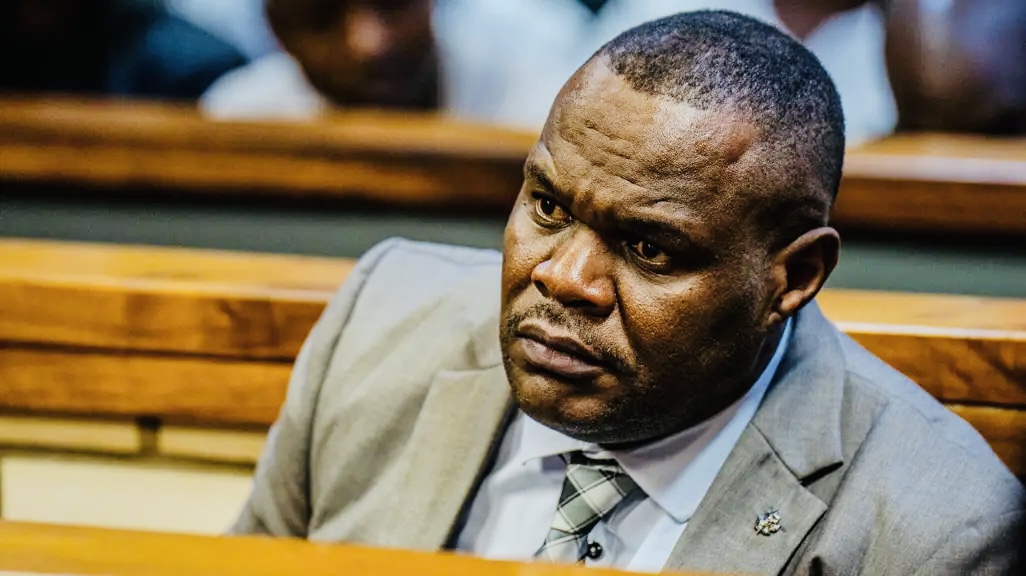
By GoodWill Mathebula: What unfolded in the Pretoria North Magistrate’s Court was not just a routine bail hearing, but a clash between two sharply opposing portraits of suspended police officer Sergeant Fannie Nkosi — one painted by the State as a protector of violent criminals, and the other by Nkosi himself as a family man, career officer and victim of what he calls a manufactured case.
Nkosi, a suspended member of the Gauteng South African Police Service (SAPS)’s Organised Crime Unit, has appeared before the Pretoria North Magistrate’s Court after being arrested earlier this month during a raid at his home in Pretoria North.
His bail application will continue on 20 April. The State has opposed his bid for release, insisting that “their evidence against him clearly showed that he was involved in protecting criminals involved in serious and violent crimes.”
The 42-year-old returned to court on Monday for a formal bail application and told the court he earns R16,500 a month and can afford bail of R10,000. But the legal battle surrounding him stretches far beyond his finances.
Nkosi was suspended on March 28 and is facing a raft of charges, including theft, defeating the ends of justice, unlawful possession of ammunition and explosives, three counts of failing to safeguard firearms, eight counts of failing to safeguard ammunition, and failure to comply with firearm safe regulations.
The State’s version places Nkosi at the centre of a troubling web of alleged criminal protection. He is accused of acting as a middleman between alleged crime boss Vusimuzi “Cat” Matlala and senior police officers.
He also testified before the Madlanga Commission in Pretoria for eight days about his alleged links to Matlala and Katiso “KT” Molefe, adding even more weight to a case already attracting intense public attention.
According to evidence previously placed before the court, police allegedly found more than R50,000 hidden under a mattress during the raid on Nkosi’s home, along with firearms, explosives and other items. That discovery has become one of the most hotly disputed elements of the case, as Nkosi has flatly denied that the weapons were improperly stored.
In an affidavit read to the court by his lawyer, Siza Dlali, Nkosi insisted that he does not understand the charges against him. “I fail to understand how I could be charged with defeating the ends of justice, theft, possession of unlicensed ammunition and possession of stun grenades,” he said. He went further, saying the charges were “fabricated” and intended to frustrate him.
Rather than focusing only on the allegations, Nkosi used his affidavit to present a full picture of his personal life, apparent stability and roots in South Africa.
He told the court he was born on September 11, 1982, is a South African citizen, and has lived in the country his entire life. “I regard South Africa as my permanent home and have no intention of relocating to another country,” he said.
He also described his home life in detail. Nkosi said he is married in community of property to Elizabeth Ntombizodwa Nkosi, a traffic police officer born on May 15, 1981. “My wife and I have a child that was born out of our marriage relationship, namely Ndomiso Sibonelo Nkosi, who was born on 3 January 2018.”
The couple own a house in Pretoria North bonded for around R1.5 million, with monthly repayments of R7,500, while their household assets and vehicle are valued at more than R500,000.
Nkosi said he has no previous convictions and no other pending criminal cases. He also told the court his family and friends are ready to post bail of R10,000, an amount he says is within his means.
In challenging the State’s case, Nkosi strongly denied any attempt to interfere with justice. “The allegation that I obstructed the ends of justice is unwarranted, as I did not engage in any conduct that would defeat or obstruct the administration of justice,” he said.
He stated that after being suspended on March 28, he immediately handed over his service firearm, access card, appointment certificate and laptop, and complied with instructions barring him from entering police premises or contacting witnesses.
He gave a similar response to the allegation that he stole police dockets, telling the court they were lawfully in his possession because of his role in a national task team dealing with cash-in-transit heists and violent crime. “I did not steal these dockets, nor did I defeat the ends of justice,” he said.
On the issue of firearms and ammunition, Nkosi denied any improper conduct inside his home. “All the firearms and ammunition in my possession were kept in a safe mounted in the wall for safekeeping,” he said. “I deny that any firearms were found under a mattress, in a bed or in a motor vehicle.” He also rejected the allegation that a stun grenade was found at his house, again calling the charge “fabricated”.
Nkosi also tried to assure the court that he is not a flight risk. Addressing his travel history, he said his last trip outside South Africa was to Botswana more than a decade ago. “I only left the Republic of South Africa in 2012 to visit Botswana, and I have not travelled again since,” he said.
He added that while he had obtained a second passport, it was solely for an official work trip that never happened. “The second passport was issued for an official trip to Italy, which was later cancelled,” he said.
According to Nkosi, both his passports are already with the investigating officer. He said he is willing to obey any bail conditions, including not applying for new travel documents.
“I have friends, family and occupational ties to this jurisdiction and will not evade trial,” he said, adding that the possible sentence if convicted would not be severe enough to justify absconding.
But the State is not persuaded. Prosecutor Tholoana Sekhonyana argued that releasing Nkosi would endanger the investigation and the administration of justice. In the State’s view, the accused officer is no ordinary applicant.
“The applicant has shielded serious criminals who are involved in violent crimes like cash in transit robberies with aggravating circumstances, instead of bringing them to court to account for their alleged wrongdoing. It will be a serious miscarriage of justice to afford bail to this applicant with this kind of character stated above.
There is a real likelihood that he will interfere with investigations and the evidence indicates that the applicant is not working alone in defeating and obstructing the course of justice, but is assisted by other officers. Should he be released on bail he will continue obstructing other matters.”
The hearing before presiding magistrate Thandi Theledi was briefly adjourned after the State said it had only received Nkosi’s affidavit on Monday morning and needed more time to prepare its response. The matter was then stood down, with proceedings expected to resume later before continuing further on 20 April.







