Subtotal R0,00

Free State/ 01 December 2025, 07:23am/Mpho Mokoena
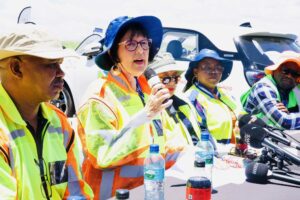
Transport Minister Barbara Creecy Says SA Works to Slash Festive Crashes: Image Supplied
By Mpho Mokoena: Transport Minister Barbara Creecy announced that while South Africa has reduced its road death toll by 700 people this year, more than 9 400 fatalities have still been recorded. The figures were disclosed during the launch of the 2025/26 festive season road safety campaign in Kroonstad, Free State, on Saturday.
Creecy framed the decline as progress within a difficult context, noting that the reduction marks the first decrease in five consecutive years. However, she warned that the death toll remains unacceptably high and urged a renewed collective effort to protect road users during the holiday period.
“Human error, whether by pedestrians or drivers, is responsible for nine out of ten accidents,” Creecy stated.
The launch, held in a province that has faced a spate of troubling incidents, coincides with a period of heightened concern for road safety in the Free State. Premier Makoena Letsoho-Mathai opened the event by acknowledging the difficult weeks the province has endured, revealing that eight early childhood development teachers died in a bus accident, with burials held in Thaba’nchu and Virginia. She added that survivors face life-changing injuries, with many requiring leg amputations.
In a direct appeal to the national minister, Letsoho-Mathai urged intensified support: “We need traffic officers, especially in this province. I hope after this, we’ll have some engagement just to find a way of how you are going to assist us, RTMC, this festive season.”
Creecy’s remarks highlighted the geographic distribution of risk, noting that Gauteng, KwaZulu-Natal, the Western Cape, the Eastern Cape, and Limpopo collectively account for seven out of ten accidents, with the majority of fatal crashes occurring on weekends, particularly after dark.
The minister used the Easter period as evidence that collective action works, pointing to historically low crash and fatality figures during that holiday period. “We were able to ensure the lowest number of crashes and fatalities that we have seen in the last three years,” she said. “Today we are once again calling on everyone in our country to join hands and reduce the festive season crashes and fatalities.”
Pedestrian safety received special emphasis in Creecy’s address. She warned that pedestrians account for more than half of all road deaths and urged individuals to take precautionary measures: walk in well-lit areas and wear visible clothing. “Please wear something that is white, not black, because it’s very difficult for you to be seen at night,” she urged.
The campaign features intensified law enforcement operations, including 24-hour patrols on weekends and in high-risk areas. A total of 800 National Traffic Police officers will be deployed to Gauteng, Limpopo, KwaZulu-Natal, and the Eastern Cape to bolster existing provincial capacity.
Critical routes identified for priority attention include the N1 from Zimbabwe to Cape Town, the N2, N3, N4, N17, and secondary roads such as the Moloto Road and the R61 in the Eastern Cape. The transport department also said that roadworthiness and load management checks will be conducted at major weighbridges, including N3 Heidelberg, N4 Donkerhoek, and N1 Manselle.
Santaco secretary-general Daki Qumbu expressed the association’s commitment to addressing driver fatigue, noting that the sector would push for safer long-distance travel. “We will continue to ensure that even during this festive season, we encourage drivers, particularly those who are doing long distances, that the operators must provide them with an extra driver so that it should be a relief driver,” Qumbu said. He added that Santaco will encourage drivers to rest after approximately 200 kilometres.
Creecy outlined fundamental safety rules to reduce human error, stressing that speeding—especially in wet conditions or at night—is unacceptable. She warned that overtaking in oncoming traffic or on a blind rise “is a death sentence for you, your passengers and the oncoming vehicle.” For long-distance travel, drivers were advised to rest every two hours.
Alcohol consumption was addressed with a clear message: “Enjoy alcohol in your home, in your tavern, but don’t get behind the wheel of a car or walk along the road after you have had a drink because your ability to judge safe distance and danger is reduced.”
A passionate plea for child safety followed: “Please, please, please put babies and children in car seats. And everyone should use their seatbelts in a car, in a bus, in a taxi. It just makes sense: if the driver has to slam on the brakes, you’re not going to fly out the window. You’ll be safe,” she explained.
As the festive season unfolds, Creecy thanked law enforcement officers who will be deployed to keep roads safe away from home. “When you are relaxing, and you’re enjoying the festive season, please spare a thought for these men and women who will be deployed far from home, far from their families, keeping you safe on the roads this festive season,” she said.
Across the country, provinces have submitted road safety programs totalling 537 planned education and awareness activities, aimed at train stations, taxi ranks, malls, churches, toll gates, and border posts.