
Subtotal R0,00

Western Cape/06 August 2026, 07:58am/Staff Writer
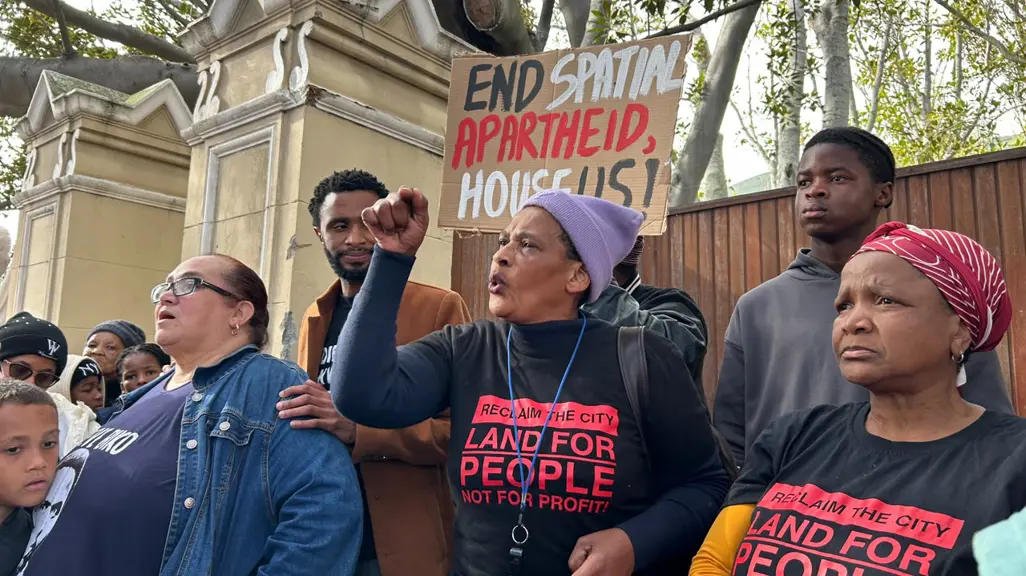
Activists march following the Constitutional Court’s judgment on the Tafelberg sale matte: Image Supplied
By Staff Writer: The Western Cape government’s decision to stay away from a parliamentary meeting on the controversial R135 million Tafelberg land sale has intensified tensions between the province, national government and lawmakers pushing for urgent housing reform.
The Human Settlements Portfolio Committee had summoned the provincial Infrastructure Department to explain the implications of the recent Constitutional Court judgment. The national Human Settlements Department attended, but the Western Cape government declined the invitation, arguing that the matter remained sub judice.
Committee Chairperson Albert Seabi said the province had indicated that it still had to return to court in three months.
“They felt in their view, according to the letter, that it is not an opportune time to brief the public,” he said.
The explanation did little to ease the anger among MPs, who viewed the absence as an attempt to avoid parliamentary scrutiny at a time when the judgment has placed land, housing and spatial inequality firmly back on the national agenda.
Seabi said the committee would not simply let the matter disappear.
“The feeling is that the apology is not accepted. We will take it forward from there.”
Human Settlements Department director-general Alec Moemi told the committee that the Constitutional Court’s decision was final and that the Western Cape could not appeal the judgment.
“The Concourt is the apex court and therefore there will be no room for appeal. The only legal avenue available is to ask for a review,” Moemi said.
He said the province now had to focus on implementing the judgment rather than searching for ways to challenge it.
Moemi said the provincial government had sought legal advice on how to comply with the court’s order and had outlined the process through which parties would file and comment on the report required by the court.
“They say they seek legal advice on the provision in the judgment to comply. They go on to outline the processes in their letter how parties will be expected to file and comment on the report the court requires,” he said.
He added that the national department was aware that the court would require a progress report from the province.
“We will comment on its efficiency once it is there, not anywhere in public,” he added.
MK Party MP Thulani Gamede said the committee regarded the Western Cape’s non-attendance as a serious affront.
“They take us for granted. The Concourt issued their ruling and we don’t take it lightly as the MK Party,” Gamede said.
ANC MP Sello Dithebe was equally scathing, saying the province’s reliance on the sub judice argument was not sufficient justification for avoiding the meeting.
“Even somebody who has a one year understanding of law understands that this is the apex court and there is a reason why our constitutional architecture was designed the way it is. There is no other court that can adjudicate. They simply have to comply. To invoke this as an excuse is very flimsy and disrespectful to the committee,” said Dithebe.
For Dithebe, the dispute was about more than one piece of land. He said the case raised questions about constitutional accountability, cooperative governance and whether political parties could undermine fundamental rights simply because they controlled different spheres of government.
“There is no one who, simply on the basis of a particular party governing a particular territory in our country, undermines fundamental rights,” he said.
Human Settlements Minister Thembi Simelane said the Tafelberg controversy should be viewed within the broader crisis facing the Western Cape, where housing shortages and spatial inequality continue to shape the lives of residents.
She said the Constitution guaranteed everyone the right to adequate housing and required all spheres of government to take steps, within available resources, to realise that right.
“It is not just in isolation to provide housing. It needs to address integrated planning with other departments,” she said.
Simelane said the province’s housing challenge required cooperation between national government, the Western Cape government and the City of Cape Town.
“It is time for us to ponder jointly as ourselves, the provincial government and the City of Cape Town on how best best to deal with the issue to address spatial inequality so that people of all of walks can access convenience, have a choice where they want to reside, and the responsibility of the government is to provide assistance and make land packages available for human settlements,” she said.
She called for stronger use of the Inter-Governmental Relations Framework to resolve disputes affecting communities.
“We all need to understand section 26 of the Constitution that mandates the City and the Province to make sure that housing is the responsibility of the State. We can’t pass it to anybody else.”
Simelane said her department would engage both the province and the City of Cape Town before returning with a plan.
“We will come back with a clear programme that outlines how we solve this. If that does not work, I will come back and tell you about my endeavours,” she said.
MK Party MP Zelna Abader said the Tafelberg judgment exposed the human cost of weak cooperation between government institutions.
“South Africans don’t need more court judgments. They need homes built on well located land that restores their dignity and humanity,” she said.
Abader urged the national department to conduct a countrywide audit of strategically located state-owned land and identify sites that could be prioritised for social and affordable housing.







