Subtotal R0,00

National News/ 19 June 2024, 16:12pm/ Staff Writer
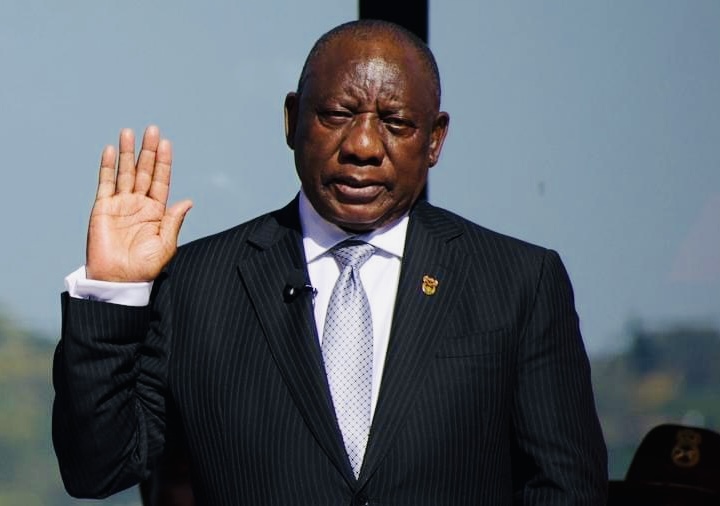
President Cyril Ramaphosa: Image Supplied
By Staff Writer: Cyril Ramaphosa was officially sworn-in as President of the Republic of South Africa’s seventh administration at the Union Buildings today. This inauguration marks the beginning of a new chapter in the nation’s democratic journey following the general elections held on May 29th.
In a historic shift, this administration will significantly differ from its predecessors as no single party obtained a majority to govern independently, necessitating co-governing agreements. “I swear I will be faithful to the Republic of South Africa,” Ramaphosa declared as he took the oath of office, a pledge binding on his conscience.
In his inaugural address, President Ramaphosa emphasized the importance of coalition governance, labelling it “the beginning of a new chapter for South Africa.” His speech was a call to the parties forming the Government of National Unity (GNU) to set aside political differences and work collaboratively for the nation’s welfare. The President noted the African National Congress’ (ANC) reduced support in the elections, which fell to 40%, as a clear indication of the electorate’s demands.
“Voters have not given a single party a mandate to govern alone and have shared their disapproval in some areas where we have failed them. They want us to put their needs and aspirations first and work together for the sake of the country,” Ramaphosa asserted. “The people of South Africa have spoken. We accept the results of the election… [the voters’] will shall be done without any doubt or any question,” he added.
Ramaphosa described the formation of the GNU as a “moment of profound significance… the beginning of a new era.” He outlined the GNU’s commitment to focusing on economic growth, social justice, and sustainable development. Key aims of the seventh administration include reducing poverty, protecting workers’ rights, ensuring government stability, enhancing state efficiency, investing in education and healthcare, ending the looting of public funds and state capture, achieving a foreign policy that emphasizes human rights and peace, upholding the Constitution, and uniting the nation.
Above all, the President stressed the necessity for unwavering fidelity to the Constitution. Responding to criticisms about forming a GNU, Ramaphosa stated, “neither discord nor dissent shall cause us to cast aside that which calls us to build a united, free, just, equal, and prosperous nation.”
Prior to the inauguration, Presidency spokesperson Vincent Magwenya announced that Ramaphosa would engage in consultations before appointing the seventh administration’s cabinet. These discussions are expected to be rigorous, given the need to accommodate the diverse parties forming the GNU.
Supporting Ramaphosa’s nomination and election were the ANC, Democratic Alliance (DA), Inkatha Freedom Party (IFP), Patriotic Alliance (PA), and other smaller parties, which are anticipated to receive cabinet positions. Freedom Front Plus leader, Pieter Groenewald, confirmed his party’s submission to join the GNU, with feedback expected soon.
While the tenure of ministers and deputy ministers from the sixth administration concluded with Ramaphosa’s swearing-in, their departments will continue operations under plans previously presented to Parliament. Historically, Ramaphosa took four days to announce his Cabinet in 2019, whereas former Presidents Thabo Mbeki and Jacob Zuma did so the day after their inaugurations, benefiting from the ANC’s outright majority.
As South Africa embarks on this new era of coalition governance, the focus remains on unity, stability, and addressing the pressing needs of its people.