
Subtotal R0,00


KwaZulu-Natal/20 March 2026, 05:30am/ Dakalo Mulaudzi
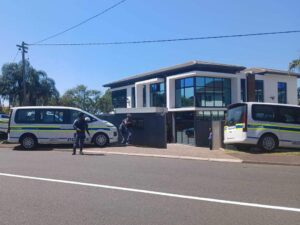
Calvin and Family Security Services Premises: Image Supplied
By Dakalo Mulaudzi: What played out at businessman Calvin Mathibeli’s Durban property on Thursday was about far more than one compliance inspection.
The police action signalled a tougher national message: SAPS is widening its campaign against the spread of firearms and turning its attention sharply toward security companies whose weapons and records may not fully align.
At the centre of the inspection is Calvin and Family Security Services, but the broader police focus is on accountability, firearm movement, and whether licensed weapons in private hands are being controlled tightly enough in a country struggling with violent crime.
KwaZulu-Natal police say the company has 815 firearms listed in its own books, while SAPS records indicate the number should be more than 850. That gap has become one of the key flashpoints in an operation now tied directly to the state’s larger anti-firearms drive.
Outside the premises, KZN SAPS spokesperson Colonel Robert Netshiunda made it clear that the inspection was part of a much wider mission.
“Police are conducting a national operation that looks at companies that deal with firearms to check if they really comply with the law.”
That operation, known as Operation Buyisa, is a nationwide SAPS initiative aimed at removing illegal firearms from circulation and tackling non-compliance among security firms and firearm dealers. In that context, the Durban inspection becomes less a local drama and more a test case in the policing of the private security sector.
The visible police deployment reflected that intensity. Heavily armed members of SAPS’s Operation Buyisa tactical unit raided the Durban North headquarters of Mathibeli’s business, with several police vehicles stationed outside and armed officers deployed around the property.
Netshiunda said police concern has grown because some firearms recovered at crime scenes have been traced back to official institutions and private security firms.
“He said police have been picking up firearms at crime scenes, and after looking at the firearms numbers, it was revealed that the firearms either belonged to the SAPS or belonged to security companies.”
That statement shifts the emphasis of the story dramatically: the inspection is not simply about paperwork, but about a national concern that firearms linked to legitimate entities may be surfacing in criminal environments.
According to police, Mathibeli had appointed a person to oversee firearms on his behalf, and that individual is now central to the verification process.
“So that person is telling us that the company has got 815 firearms in their books, in their safes.
“That for now does not correspond with the record that we have as the police, because our records indicate that this company should be having at least over 850 firearms,” he told the media outside the premises.
Police said some of the discrepancy could still be explained as the inspection continues.
“But, they are also saying that 11 of their firearms are at Inanda SAPS, because they are saying they were taken from a security company, which was operating somewhere in Cator Manor.
“That also needs to be verified, because we have to go to our SAPS stores in Inanda to check if those firearms are there, but that number does not necessarily have to be in one place, because they said they have got sites in at least four properties.”
The matter is further complicated by the company’s operational footprint across different areas.
“Here in Cator Manor, they have got two more sites in Newcastle, a site in Gauteng, in Limpopo, and Western Cape as well.”
He said if the firearms are not accounted for on site, “that means this operation must go to all those sites where they are saying the firearms are.”
In that sense, the Durban inspection could be only the starting point of a much larger verification process stretching across provinces.
Police also highlighted what they say are troubling flaws in the handling of firearm records.
“What’s of concern for now is that the registration of that firearm is not properly completed.
“Firearms were moved from this place to another place without proper documentation to say how many firearms were moved, serial numbers, and who received them, because you must sign that I received the firearm, you must sign that I respect the firearms, but so far that is not done right.”
Netshiunda said another concern was the use of pencil in official firearm registers.
“And the concern is that the law or the Act says that the register must be completed with a permanent ink. So here we are seeing a pencil completing the register, which can be erased at any time.
“But safe to say, we are still operating, and we believe that once we are done, we will be able to connect the dots, if there are any wrong steps that need to be taken.”
The inspection was carried out after Mathibeli failed in court to stop it. The Durban High Court dismissed his urgent application to interdict SAPS from proceeding.
“The court found that Mr Mathibeli’s application lacked urgency and dismissed it with costs. He was ordered to pay legal costs to SAPS,” police spokesperson Lieutenant Colonel Vincent Mukhathi said.
Mukhathi said members of Operation Buyisa proceeded with the inspection on 19 March as mandated by the Constitution and in terms of Section 109 of the Firearms Control Act 60 of 2000.
He described the operation as part of SAPS’s larger effort to curb the spread of firearms.
“As part of SAPS’s priority to curb the proliferation of firearms in the country, members of Operation Buyisa continue to conduct operations across multiple provinces to track down and confiscate firearms from security companies operating outside the ambit of the law, including illegal firearms,” Mukhathi said.
He added that compliance inspections are being conducted nationwide to ensure that security companies, dealers and individuals adhere to firearm regulations.
“In combating gun-related violence, SAPS is intensifying efforts against the proliferation of firearms by conducting licence and compliance inspections at security companies holding firearms,” he said.
Netshiunda stressed that the implications of non-compliance could be severe.
“Anything that has to do with a firearm is serious.
“Firearms kill people, and firearms are used at robberies, at CITs.
“So anything that has to do with firearms is serious. So there are serious implications to the point that we can confiscate all the firearms and ensure that the licence is revoked if the findings are so severe that we can’t give a fine or anything of that sort.”
He also made it clear that the process would not be rushed.
“Because if you’re talking about over 800 firearms, that’s a huge number. We must go and inspect each and every firearm one by one on its own merit.
“We must know where it is. And it’s not only firearms, ammunition as well. We must know how many are accounted for. So everything must be checked thoroughly.
“If it takes two days, it’s two days. If it’s two months, it’s two months. We need to ensure that we do this inspection thoroughly until every firearm is accounted for.
“If there are firearms that are not accounted for, cases will be opened and people who are responsible must face the music,” he added.







