
Subtotal R0,00

News/04 May 2026, 09:08am/ Dakalo Mulaudzi
By Dakalo Mulaudzi: A police operation on the Komati River has taken a chilling turn after officers recovered human remains from inside a massive crocodile believed to be linked to the disappearance of a 59-year-old Gauteng businessman.
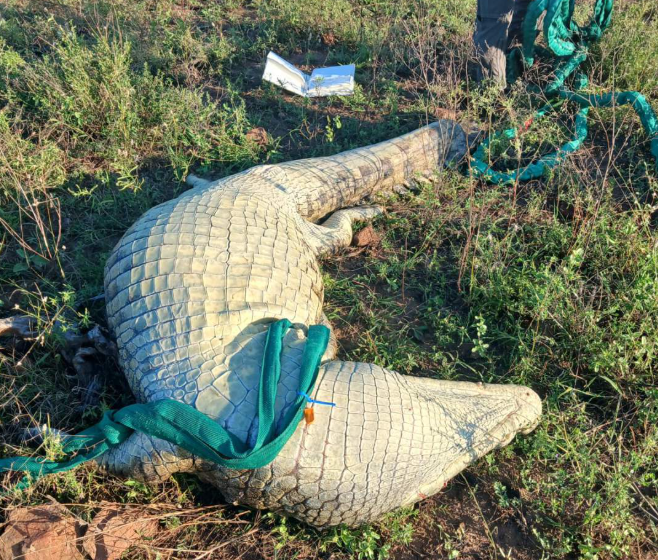
The operation, carried out under dangerous conditions near Komatipoort, saw Captain Johan “Pottie” Potgieter hoisted from a SANParks helicopter into crocodile-infested waters to secure the reptile. The animal, weighing about 500kg, was later euthanised and removed from the river. Investigators then found body parts in its intestines and stomach, including two human arms, part of a ribcage and tissue from the chest.
Authorities say DNA testing will now determine whether the remains are those of the missing businessman, who vanished last month after his Ford Ranger was found trapped on a flooded low-level bridge.
The grim breakthrough followed a week-long search involving the Saps Search and Rescue Unit, NatJoints, SANParks, Emergency Medical Services, Securecon and the Port Management Committee.
Police spokesperson Colonel Mavela Masondo said: “Following a week-long search for the missing businessman, the team identified a crocodile in the river suspected to have carried out the attack. The necessary permission was obtained to euthanize the crocodile. It is then that the human remains were found and retrieved.”
But behind the shocking discovery was an intense game of patience, skill and experience. Police divers and search teams spent days watching crocodile behaviour in the river, using drones and helicopters to track movement and identify one animal that stood out from the rest.
Potgieter said: “We have been working in the Lowveld for a very long time and we know the mannerisms of the crocodiles by now.”
He explained how the team’s suspicions narrowed around one reptile that refused to leave the area where the missing man was believed to have been swept from the bridge.
“During the search, we saw that this particular crocodile was only about 150 meters away from where the person had washed off the bridge. This crocodile stayed there the whole time. When the helicopter went over it, it wouldn’t move away.”
For experienced rescuers, that behaviour was telling.
“We know from experience that if crocodiles have had a big meal, they’re not very active, and need to lie in the sun for their digestive system to start working,” Potgieter said.
In a decision that underscored the danger of the mission, Potgieter chose to conduct the recovery himself rather than place his team at greater risk.
“When I speak to my members and ask them to do something, I always tell them, ‘I wouldn’t ask you to do it if I wouldn’t do it myself’. In this case, because it was dangerous, I didn’t want to use the other members; I would rather do it myself.”
He admitted the operation could easily have turned deadly.
“It was a dangerous thing. A lot of things could’ve gone wrong. When they hoisted me up, my harness could’ve broken. The helicopter could have had a malfunction. We had a lot of wind on that day and there were chances I could have been blown into the trees.”
Acting Provincial Police Commissioner in Mpumalanga, Major General (Dr) Zeph Mkhwanazi, praised the multi-disciplinary team for refusing to abandon the search despite the life-threatening conditions.
“I give honour to the dedicated team that has put their lives in danger to find the missing person. I know it was not easy, but they did not give up, even when faced with a dangerous situation,” said Mkhwanazi.
For all the horror of the find, Potgieter said the mission was ultimately about one thing: giving a family answers.
“They need to know that their loved one is either alive or that he is deceased and has been found. Even though it is a tragedy, you have to get that closure so that people can carry on.”
What began as a missing-person search on a flooded bridge has now become one of the most haunting recovery operations in recent memory — a story of courage in the air, danger in the water, and a devastating end waiting inside a river predator.







