Subtotal R0,00

News/ 29 October 2025, 08:40am/ Ayanda Shezi
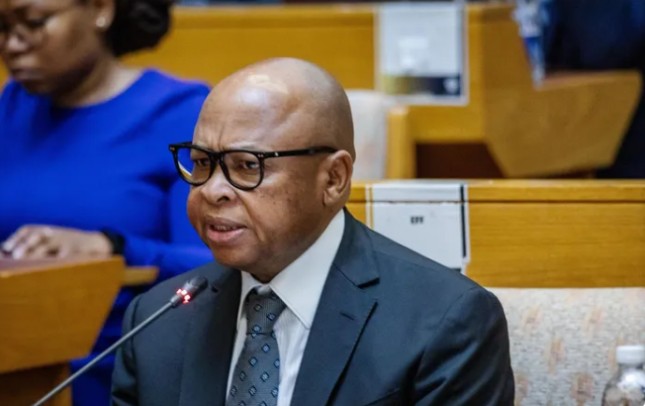
Deputy Police Minister Cassel Mathale Testifies Before Parliament’s ad hoc committee. Image Supplied
By Ayanda Shezi: Deputy Police Minister Cassel Mathale has told Parliament that suspended Police Minister Senzo Mchunu has not assigned any formal duties to him or to fellow Deputy Minister Polly Boshielo since their appointments to President Cyril Ramaphosa’s cabinet more than a year ago.
Mathale was appearing before Parliament’s ad hoc committee investigating allegations of corruption, political interference, and criminal infiltration within South Africa’s justice and policing systems. He said that since taking office in June 2024, Mchunu had not delegated any responsibilities to either of the deputies, explaining that the minister was still “familiarising himself” with the role.
“The minister is still getting to grips with his responsibilities, and no tasks have been assigned to me or Deputy Minister Boshielo,” Mathale told the committee.
The committee also heard evidence about the controversial Political Killings Task Team (PKTT), which was established to tackle politically motivated murders, particularly in KwaZulu-Natal.
Mchunu, during his earlier testimony, described the unit as an unnecessary financial burden to the South African Police Service (SAPS) and claimed that its mandate had expired in 2022.
Mathale rejected those claims, saying the unit’s work had continued lawfully and with ministerial approval. He referred to former Police Minister Bheki Cele’s 2023 directive that extended the team’s mandate.
“When it comes to regular expenditure for the PKTT, such costs can only arise if the unit operates legally,” Mathale said. “If its existence were illegal, any expenditure would also be illegal.”
He added that at no point had the task team operated outside the law or beyond its approved timeframe.
Committee members questioned Mathale about his working relationship with Mchunu and the overall structure of the police ministry. Mathale said he and Mchunu maintained a good working relationship but confirmed that no specific duties had been assigned to him.
He explained that the police ministry was one of the most complex government departments, encompassing several divisions — including the Directorate for Priority Crime Investigation (DPCI), the Civilian Secretariat for Police, and other oversight entities.
“You cannot simply walk in and immediately know who does what,” he said. “Delegation happens once the minister fully understands the ministry, and that has not happened yet.”
Mathale noted that despite the lack of delegated tasks, the size and scope of the police ministry justified the need for two deputy ministers.
“This department is not like others. SAPS operates through multiple entities that function almost as departments within a department. Effective oversight requires more than one deputy minister,” he said.
The deputy minister also clarified how the instruction to disband the PKTT was drafted and communicated. He said that during a meeting earlier this year, Mchunu had informed the portfolio committee that the task team would be phased out as part of a transitional process.
“Although the national commissioner may present documents, the decision ultimately comes from the minister as the executive authority,” Mathale explained. “The letter instructing the disbandment was part of that process.”
He said that without this letter, the current parliamentary inquiry might not have been established.
Democratic Alliance MP Glenys Breytenbach asked Mathale whether acting Police Minister Firoz Cachalia had delegated any duties to him since Mchunu’s suspension. Mathale confirmed that while he and Cachalia had discussed roles, no formal delegation had yet been made.
When asked what he would prioritise if he were police minister, Mathale highlighted the need for greater coordination between leadership structures.
“Working closely with the national commissioner and holding regular meetings would improve communication and performance,” he said. “We carry huge responsibilities, and consistency in engagement is critical.”
The ad hoc committee’s inquiry into corruption, interference, and inefficiency within South Africa’s policing structures is ongoing. Mathale’s testimony is expected to continue until Wednesday, as Parliament examines the operational and leadership challenges facing the police ministry.