
Subtotal R0,00

News/21 May 2026, 09:21am/Sipho Gumede
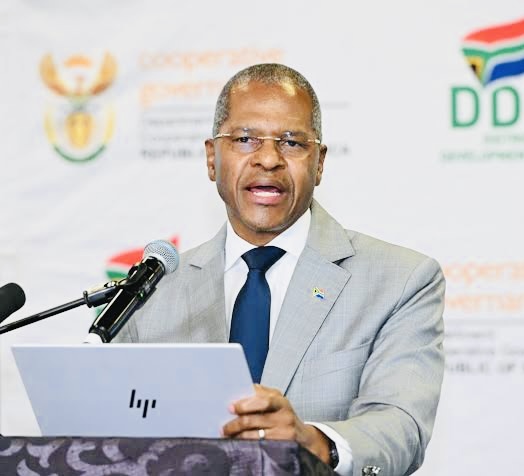
Velenkosini Hlabisa: Image Supplied
By Sipho Gumede: South Africa’s next local government elections could usher in a new era of stricter coalition politics, with parties set to be compelled to put their promises to one another in writing — and be bound by law to honour them.
That was the standout message from Cooperative Governance and Traditional Affairs Minister Velenkosini Hlabisa, who used his department’s R423.4 billion budget vote in the National Assembly on Wednesday to sketch out a far more hard-edged future for municipalities after the 2026 polls.
In a speech that shifted attention from budgets to political accountability, Hlabisa made it clear that the government wants to curb the chaos that has often plagued coalition-run councils. At the centre of the planned reforms is a requirement that parties forming coalitions after the 4 November 2026 local government elections must sign formal agreements spelling out exactly who is responsible for what.
“Political parties that will form coalition governments post-November local government election will be required to enter into formal written agreements outlining their commitments and responsibility.
“These agreements will be legally binding and will help to maintain stability in the municipal council,” he said.
The proposed change signals a tougher approach to local governance, especially in municipalities where fragile alliances, leadership battles and collapsing service delivery have become a familiar pattern.
Hlabisa said the reforms under way were aimed at fixing municipalities at their core.
“These reforms are about one thing: stabilising municipalities so that service delivery becomes reliable, predictable, and consistent.”
His remarks framed the budget not simply as a spending plan, but as part of a broader attempt to reset local government before voters head to the polls next year.
Preparations for the election, he said, were already well advanced. The Inter-Ministerial Committee on municipal elections is in place, council numbers are being finalised, and the delimitation of 4,488 wards is under way, while the Independent Electoral Commission continues work including voter registration.
“The key principle guiding us in preparing for the local government elections on 4 November 2026 is that the elections must be free, fair, credible and beyond reproach,” he said.
But beyond election readiness, Hlabisa’s speech also pointed to a bigger political diagnosis: that the system governing municipalities has not kept pace with the pressures they now face.
He said the review of the 1998 White Paper on Local Government had now been completed under the theme that every municipality must work.
“This is not a slogan, it is a commitment,” he said.
According to Hlabisa, the revised policy document accepts that the local government landscape has changed dramatically since the late 1990s.
“The revised White Paper recognises that local government today operates in a far more complex environment than in 1998. It provides a renewed and realistic framework to strengthen governance, accountability, and service delivery to give effect to this,” said Hlabisa.
The minister, who was tabling the department’s budget for the second time under the Government of National Unity, said R422.5 billion had been allocated to cooperative governance and R900 million to traditional affairs.
He stressed that the money should not be seen as a technical line item in the national books.
“This budget, honorable members, is not an accounting exercise. It is a delivery instrument. It must translate into functioning municipalities and improve lives, reforming the local government system.”
He said public frustration with failing municipalities was justified, adding that councils could not function properly where appointments were irregular, leadership unstable and oversight weak.
“We are, therefore, strengthening competency-based recruitment, professionalisation of municipal administration, performance management systems, and ethical leadership.
“The introduction of the code of ethical leadership, together with the ethics training program, is reinforcing accountability.”
In a rare note of optimism, Hlabisa said there were signs of improvement in local government performance despite the long-running problems.
“Fifty nine municipalities have improved their audit outcomes, and 41 municipalities have achieved clean audits. This tells us something important. Where there is discipline, monitoring and consequence management, improvement follows.”
He also announced that a series of bills would soon be brought before Parliament to reinforce the reform drive. These include the Local Government General Laws Amendment Bill, intended to improve governance and operations, the Municipal Structures Amendment Bill, and the Coalitions Bill aimed directly at political instability in hung councils.
Further legislative changes are also on the table. Hlabisa said the Independent Municipal Demarcation Authority Bill would boost transparency and accountability, while the draft Fire Services Bill would modernise fire services governance.







