Subtotal R0,00

National News/ 19 September 2024, 09:30am/ Lijeng Moruthane
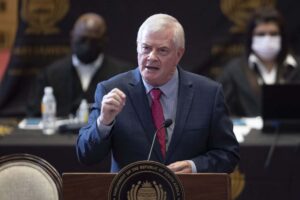
Minister of Correctional Services Pieter Groenewald approved roughly 6% of the parole applications pending for those serving life sentences: Image Supplied
By Lijeng Moruthane: Correctional Services Minister Pieter Pieter Groenewald is set to take a strict approach toward potential parolees.
The Minister has been working through a backlog of parole applications, having finalized 325 out of the 495 that were pending when he took office after the 29 May government was formed.
His office stated that the remaining 170 applications are expected to be completed by 15 October, while the 60 applications from life-sentenced individuals, submitted in the past 10 weeks, have already been reviewed.
Although the minister holds the final say, decisions are made based on evaluations conducted by the National Council of Correctional Services.
According to media liaison Euné Oelofsen, only 5.97% of the applicants met the necessary criteria.
Of the 385 applications assessed, just 23 were approved, with one person granted day parole, which allows for daytime release with a return to the facility at night.
The other 361 applicants were provisionally denied for failing to meet the minimum standards.
These applications were evaluated in line with the Correctional Services Act 111 of 1998, along with two key court rulings that differentiate based on when the life sentences were imposed.
The Van Wyk vs Minister of Correctional Services case applies to life sentences handed down before 1 October 2004, while the Phaahla vs Minister of Justice and Correctional Services case covers sentences from that date onwards.
Since the Van Wyk decision in July 2011 by the North Gauteng High Court, at least 4,300 offenders have had their situations improved due to “credit earned.”
The Phaahla ruling from the Constitutional Court in May 2019 has impacted more than 1,600 inmates by rendering parts of the Correctional Services Act unconstitutional.
In both rulings, those serving life sentences can apply for parole after 13 years and four months.
According to Act 111 of 1998, offenders aged 65 and older are eligible for parole after serving 15 years, provided they do not meet the definition of “dangerous criminals” as described in the Criminal Procedure Act.