
Subtotal R0,00

Free State/17 March 2026, 13:56pm/ Sipho Gumede
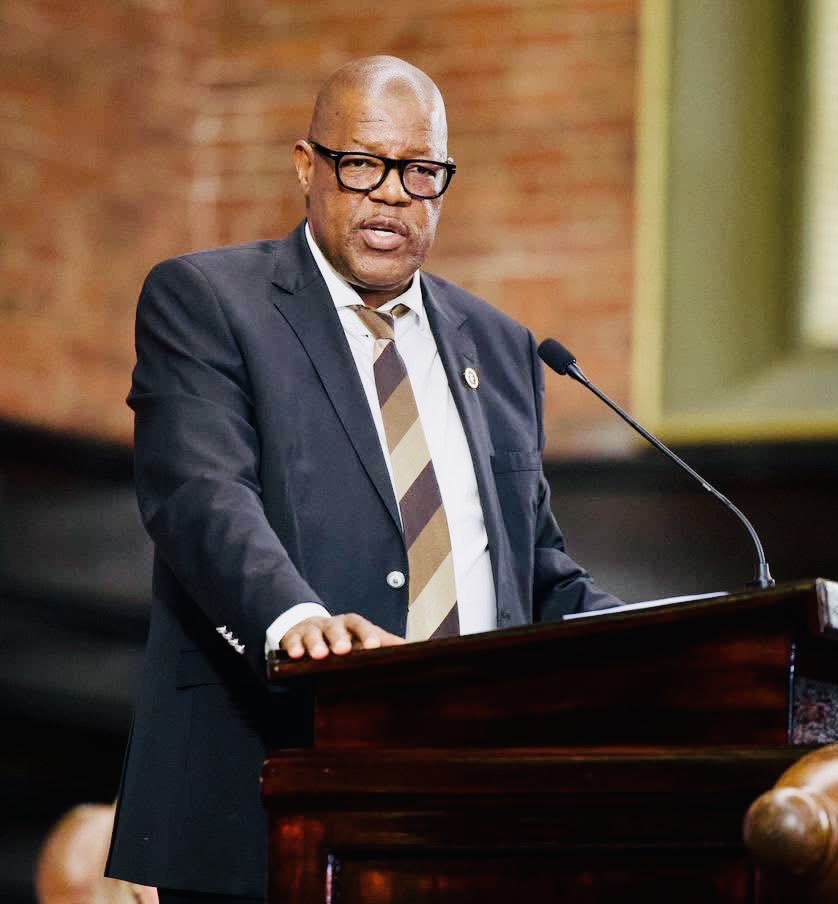
Finance, Economic Development and Tourism MEC Ketso “Toto” Makume: Image Supplied
By Sipho Gumede: What could have been just another dry budget vote became something far more urgent on Tuesday: a declaration that the Free State is trying to rebuild itself from the inside out.
When Finance, Economic Development and Tourism MEC Ketso “Toto” Makume rose in Bloemfontein City Hall to table a R47.9 billion provincial budget, the headline was not simply the money. It was the message.
In a province weighed down by municipal collapse, service delivery strain and public frustration, Makume pitched the 2026/27 budget as a recovery blueprint — a plan less about accounting and more about restoring the machinery of government before it fails citizens completely.
Dressed in a sharp black suit and speaking with visible resolve, Makume confronted the contradiction at the heart of provincial government: how to promise growth while absorbing a R332.6 million budget cut.
Yet instead of retreating into caution, he made the case that the Free State can still move forward — if it spends smarter, collects revenue better, and fixes the local institutions that have become symbols of dysfunction.
In that sense, this was not a feel-good budget. It was a repair budget.
Makume’s speech made clear that the province sees local government as the front line of the crisis. Eight municipalities — including Mangaung Metro — are already under intervention in terms of Section 139 of the Constitution, with teams deployed to tackle financial instability, governance failures, weak institutions and collapsing service delivery. The subtext was unmistakable: provincial growth means little if municipalities remain broken.
That shift in emphasis changes the angle of the budget entirely. Rather than selling a grand spending spree, Makume effectively argued that economic revival begins with competent administration. Roads, clinics, schools, supplier payments and basic local governance are no longer side issues — they are the economy.
There were, however, signs of cautious optimism. The province’s GDP growth is projected to rise from 1.1% in 2025 to 2.4% by 2029, a modest but politically important signal that Free State is not stuck in permanent drift.
Treasury also expects savings through the Early Retirement and Voluntary Exit Programme, with R261 million projected in 2026/27, followed by R206 million and R210 million over the next two years.
For a fiscally pressured province, those savings may offer breathing room — though they will also raise questions about whether the state can cut costs without weakening already strained services.
Makume also zeroed in on an issue that rarely dominates headlines but shapes the survival of small businesses across the province: late payment by government.
He noted slight improvement in paying suppliers within 30 days, framing this not as a technical compliance issue but as an economic lifeline. In a fragile provincial economy, delayed invoices can mean shuttered small firms, lost jobs and deepening distrust in the state.
The budget, he insisted, will be driven by the province’s 2024–2029 Medium Term Development Plan priorities: inclusive growth and job creation, reducing poverty and the cost of living, and building a capable and ethical state. That language may sound familiar, but this time it was delivered against the hard reality of intervention, restraint and administrative repair.
The biggest slices of the budget tell their own story. Education takes the lion’s share at just over R20 billion, followed by Health at R15 billion — together consuming the overwhelming bulk of provincial spending and underscoring where the social pressure lies.
Community Safety, Roads and Transport receives R3.5 billion, while Public Works and Infrastructure gets just above R2.3 billion, suggesting that government sees logistics, mobility and state infrastructure as central to stabilisation. Human Settlements is allocated R1.1 billion, Agriculture R1 billion, and Social Development more than R1.4 billion.
Smaller but politically significant allocations include R533.3 million for Economic Development and Tourism, R483.5 million for COGTA, and R403.9 million for Provincial Treasury. The Office of the Premier receives R658.3 million in 2026/27.
By the close of the speech, Makume also paused to offer condolences to the Lekota family following the passing of former Free State Premier Mosiuoa Patrick “Terror” Lekota — a reminder that even on a day dominated by fiscal arithmetic, history and politics still hung heavily in the chamber.







