Subtotal R0,00

Politics/ 18 September 2025, 07:58am /Jonathan Thomas
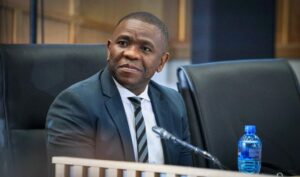
General Nhlanhla Mkhwanazi: Image Supplied
By Jonathan Thomas: A ripple of urgency ran through the Madlanga commission of inquiry as KwaZulu-Natal’s police leadership testified about a decision that could alter the face of crime-fighting in the province—and perhaps beyond.
Nhlanhla Mkhwanazi, the provincial police commissioner, told the inquiry that suspended Police Minister Senzo Mchunu disbanded a political killings task team in December 2024 via WhatsApp, and without receiving a formal briefing on the unit’s work.
The commission, chaired by retired judge Mbuyiseli Madlanga, is probing allegations of police corruption and governance lapses. The backdrop to the testimony is a minister on special leave, with Firoz Cachalia acting as police minister, as South Africa grapples with how political considerations intersect with policing.
The task team was formed in 2018 to tackle a wave of assassinations of politicians and traditional leaders in KwaZulu-Natal, following recommendations from the Moerane Commission. The unit’s cross-disciplinary approach across SAPS and other structures had, according to Mkhwanazi, yielded notable results and even led to its expansion to the Eastern Cape.
In a striking recounting, Mkhwanazi described how the order to shut the team came not through official channels but via text and a WhatsApp message, calling the move “irrational and irregular.” Read aloud from a message read into the record, he quoted Mchunu as writing: “My observation in this regard, as indicated above is that further existence of this team is no longer required as is it adding any value to policing in South Africa.
I therefore direct that the political killings task team be disestablished immediately.” While the minister argued the unit had outlived its usefulness, Mkhwanazi contested that assessment, pointing to the team’s demonstrated work and its impact.
“I have displayed earlier today, also in the [affidavit] the work that the team has done, the success rate, the performance that influences the acts to be given to the team,” he stated, underscoring the unit’s track record.
The testimony also touched on broader consequences. Mkhwanazi said that in July he had told journalists that 121 case dockets had been taken from the task team in early 2025 to shield suspects, a move later reversed when dockets were returned to the team on 28 August. SAPS announced that this reversal contributed to arrests in a case connected to whistleblower Xolani Ndlovu Ntombela.
The commission heard that the task team had the highest success rate in the police service and was extended to the Eastern Cape as a result. “So for a minister to reach this conclusion, worse because the minister has not received a formal briefing on the work that this team is doing … it was a wrong conclusion that the minister has reached, which is why it became a matter of concern,” Mkhwanazi testified.
Asked whether the decision to disband reflected policy or policing, Mkhwanazi replied that, “In my opinion, views, and experience I have in the police, this is a letter that is operational, not policy.”
He maintained that the directive targeted operational work within SAPS, and noted the unit’s unique position as the only one among 11 national teams to receive such a lead.
Evidence leader Mahlape Sello pressed for the potential consequences. If the unit were disbanded, dockets would likely be redistributed among individual investigators, diluting the inter-disciplinary approach that had made the unit effective. “It is my belief that, perhaps, as I had said in the public, in the very same month of January, that someone influenced the minister to do this,” he added, suggesting external influence.
Mkhwanazi described informal efforts to alert Mchunu about the problems faced by SAPS in KwaZulu-Natal, including invitations for a briefing and a request for a direct meeting. He said the minister never requested a briefing before disbanding the unit, and that he had even invited the minister to visit KwaZulu-Natal to see operational challenges firsthand.
“One of the remarks I made in my presentation was to invite him to visit KZN so that he get to experience some of the operational challenges that we have as a province, especially because he’s a resident of the very same province,” he recalled.
When pressed about whether Mchunu had accepted the invitation, Mkhwanazi said, “We have never received an invitation at all.” He added that he asked the deputy national commissioner for crime detection, Shadrack Sibiya, to intervene, but Sibiya was also suspended, creating a governance gap.
“I did not hear from the deputy national commissioner … [he] never really came back to me to tell me what is the next course of action,” Mkhwanazi said, explaining a lack of response that pushed him to consider escalation to the presidency.
He noted that the task team had been established after an interministerial process and that oversight was shared by a group of ministers on behalf of the president.
Facing a wall of doors that would not open, Mkhwanazi said he ultimately contacted Ian Cameron, chair of Parliament’s police portfolio committee, after concluding that “every door I’m knocking, nothing is happening.” He argued against disbandment in Parliament but did not receive a response.
Regarding the unit’s budget, Mkhwanazi said it had been reduced in size with a three-month budget for April to June 2025.
He previously indicated in his affidavit that the task team had been disbanded, but information later suggested the team’s budget had been approved through March 2026.