
Subtotal R0,00

News/31 May 2026, 08:23am/ Mpho Mokoena

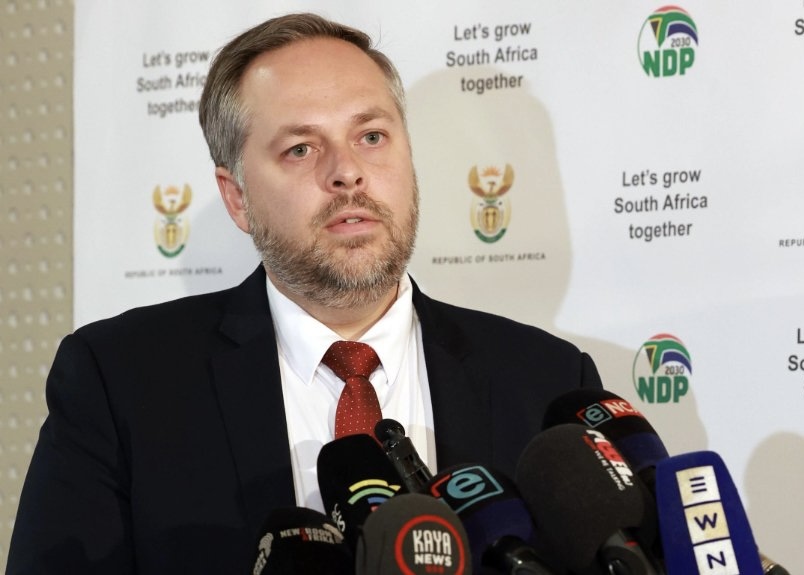
Leon Schreiber: Image Supplied
By Mpho Mokoena: South Africa’s citizenship system is facing renewed scrutiny after Home Affairs Minister Leon Schreiber confirmed that the government cannot produce a verified count of South Africans who also hold foreign citizenship — a revelation landing at a politically sensitive moment for immigration enforcement, border control and national documentation.
The disclosure followed questions from African Transformation Movement MP Vuyo Zungula, who asked whether the Department of Home Affairs could provide records showing how many South Africans hold dual or multiple citizenship, and which foreign countries feature most prominently in those cases.
In his written reply to Parliament, Schreiber said the Department of Home Affairs “does not maintain a comprehensive or consolidated register of South African citizens who hold dual or multiple citizenship.”
The admission has placed a spotlight on a growing administrative and political dilemma: while public debate intensifies around undocumented migration, border security and citizenship verification, the state itself does not have a complete picture of how many of its own citizens hold another nationality.
Schreiber, however, pushed back against the suggestion that the gap was simply bureaucratic failure. He said the absence of such a register was “not due to a failure of administration, but rather a function of the current constitutional and legal framework.”
At the centre of the issue is South Africa’s changing citizenship law. Under the South African Citizenship Act of 1995, citizens were previously required to apply to retain their South African citizenship before voluntarily acquiring citizenship of another country. That system gave Home Affairs at least some administrative trail of citizens intending to naturalise elsewhere while keeping their South African status.
But that legal requirement has now fallen away.
Schreiber said a Constitutional Court judgment delivered on May 6, 2025, declared the relevant provision unconstitutional with retrospective effect.
“As a result, South Africans no longer lose their citizenship when acquiring another nationality, and there is no longer any legal obligation to notify the Department,” Schreiber said.
The ruling has major implications for how the state tracks nationality. Without a legal duty to inform Home Affairs, South Africans who obtain citizenship elsewhere may remain invisible in the department’s records — particularly where foreign nationality is acquired automatically through birth, descent or marriage.
Schreiber said this global reality made a complete database difficult, if not impossible, under the current legal framework.
“Accordingly, the absence of a consolidated figure is not a failure of administration, but a reflection of the Constitutional Court ruling, jurisdictional limits, and the realities of global mobility,” Schreiber said.
Asked directly for the total number of South Africans with dual or multiple citizenship, Schreiber’s answer was blunt: “A verified total number of South African citizens holding dual or multiple citizenship is not available”.
He said Home Affairs could only provide administrative information linked to retention-of-citizenship applications processed during certain periods. But those records, he stressed, represent “only a subset of dual citizenship cases”.
The department has created an online citizenship portal to assist people in checking and updating their citizenship status on the National Population Register. But Schreiber made it clear that the tool is not designed to build a full national database of dual citizens.
“However, this platform is intended to regularise individual records, not to create a complete register of all dual or multiple citizens,” he said.
The minister also warned that even country-by-country figures would be unreliable. Responding to questions about which foreign countries account for the highest number of South Africans with dual citizenship, Schreiber said the department “does not maintain comprehensive country-specific statistics reflecting all instances of dual citizenship.”
Any figures that could be extracted from existing records, he added, would be based only on partial datasets, such as applications that indicated an intended country of naturalisation. Such data would “not provide a complete or reliable measure”.
Still, Schreiber said historical application patterns showed “a sustained demand over time”, broadly reflecting migration trends and socio-economic pressures that influence South Africans to seek opportunities abroad.
“While these applications provide an indication of the volume of South African citizens seeking to acquire additional citizenship while retaining their South African citizenship, they do not reflect the full extent of dual or multiple citizenship due to the limitations outlined above,” he said.
The issue comes as immigration remains one of the most politically charged subjects in the country. Public concern has grown over undocumented migration, strained public services, asylum backlogs, porous borders and the capacity of the state to verify identity and citizenship.
In recent months, protests linked to undocumented migration have taken place in parts of Johannesburg and Durban, adding pressure on government departments responsible for migration management, refugee processing and documentation.
Parliament’s Portfolio Committee on Home Affairs has also previously raised concerns about administrative inefficiencies, litigation delays and mounting pressure on the department’s immigration and refugee systems. Those concerns have sharpened as opposition parties and civic groups demand stricter immigration enforcement and stronger border controls.
The latest parliamentary reply now adds a different dimension to the debate: not only must the state track foreign nationals entering and living in South Africa, it must also grapple with gaps in its understanding of South Africans whose citizenship status crosses international borders.
Schreiber said Home Affairs was continuing to improve its data systems through modernisation initiatives, but acknowledged that “historical and legal constraints remain a limiting factor in producing a comprehensive dataset on dual or multiple citizenship.”







