
Subtotal R0,00

KwaZulu-Natal/08 October 2026, 06:56am/ Christopher Martins

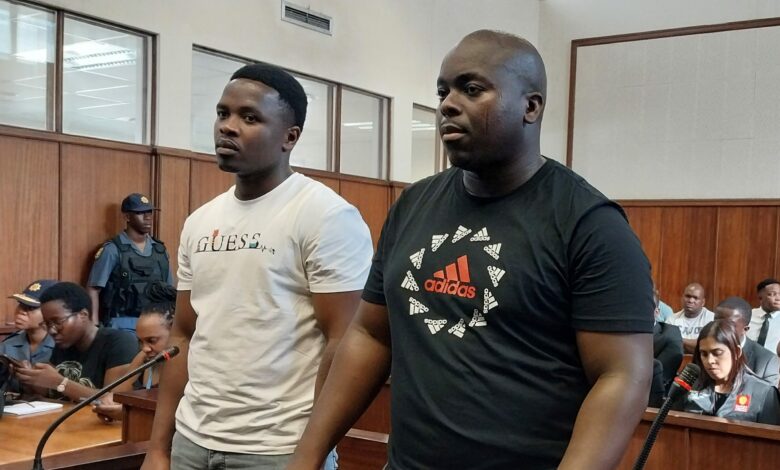
Siyabonga and Malusi Ndimande: Image Supplied
By Christopher Martins: The murder trial linked to the killing of rapper Kiernan “AKA” Forbes and his close friend Tebello “Tibz” Motsoane entered a new era of public scrutiny on Wednesday, as Judge Nomfundo Sipunzi relaxed restrictions on media reporting while the Durban High Court ramped up security measures.
In an amended directive, Sipunzi ruled that accredited journalists may now report on witness testimony as it unfolds — a significant shift for a case that has gripped South Africa since the high-profile murders outside a Durban restaurant in February 2023.
But while the courtroom doors have opened wider to public reporting, the identities of witnesses remain strictly protected.
“All accredited media houses and other forms of media are permitted to attend, observe, report on and broadcast the trial proceedings,” Sipunzi ruled.
The decision means reporters can now cover witness evidence in real time, as well as pleas, arguments by lawyers, court rulings, orders and any eventual judgment.
“Media representatives may publish or broadcast the evidence of witnesses while they are testifying, and any exhibits admitted or tendered as part of the trial record.”
Judge Sipunzi made it clear that the revised media access does not extend to revealing who the witnesses are.
“The court recognises the importance of the principles of freedom of expression and open justice, while at the same time safeguarding the constitutional right of the accused persons to a fair trial and protecting the interests of witnesses who may be called to testify,” said Sipunzi.
The court’s prohibition on exposing witnesses was unambiguous. Sipunzi stated that strictly “no media coverage shall disclose the identities or personal particulars of any witness called by either the state or the defence”.
The ruling attempts to strike a delicate balance: allowing the public to follow one of the country’s most closely watched criminal trials, while protecting witnesses and preserving the accused men’s right to a fair trial.
Courtroom transformed after phone security scare
The expanded reporting order came as security was visibly tightened in and around the Durban High Court.
Proceedings were cut short on Tuesday following security concerns after one of the accused was allegedly handed a cellphone. When court resumed on Wednesday, police officers were stationed inside and outside the courtroom, while private security personnel monitored the proceedings.
Saps officers stood on either side of the seven accused, and a bench was moved to the front of the public gallery to increase the distance between the dock and members of the public.
Access to the courtroom was also heavily controlled:
- Court officials were restricted to the front section of the courtroom.
- Media representatives were moved to the public gallery.
- The first bench behind the accused was declared off-limits.
- Entry was limited to advocates and accredited media houses.
The court also imposed firm rules on cameras and recording equipment.
“All video cameras, filming equipment, and audio-recording devices shall remain stationary and shall be positioned in a manner that does not disrupt the proceedings or distract participants.”
Photographs may only be taken when court is not in session.
Sipunzi indicated that the rules could still be revisited as the trial develops, saying: “These directives may be amended, supplemented or varied by further order of the court should the interests of justice so require.”
The trial continued after Sipunzi granted an application to separate proceedings involving Siyanda Myeza.
The judge ruled in favour of six accused who argued that dealing with independent charges against Myeza alongside their matter would result in unfair delays.
Lindokuhle Mkhwanazi brought the application for the trials to be separated. The accused named in the matter are Lindokuhle Mkhwanazi, Lindani Ndimane, Siyanda Myeza, Mziwethemba Gwabeni, Lindokuhle Ndimande, Malusi Ndimande and Siyabonga Ndimande.
With the media now permitted to report directly on testimony, the proceedings are expected to attract even more intense public attention — while the court maintains a tight grip on security and witness protection.







