
Subtotal R0,00

News/09 June 2026, 07:24am/ Linda Mgomezulu
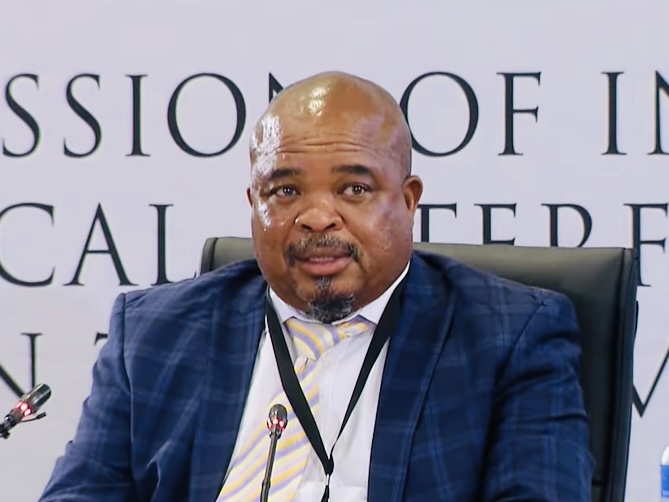
Nkoana Sebola: Image Supplied
By Linda Mgomezulu: What was once presented as a major police success in the seizure of 751kg of drugs in Aeroton has now been recast as something far darker: a murky operation allegedly driven from inside law enforcement, steered by underworld pressure, and facilitated by businessman Tumelo Nku.
At the Madlanga Commission, Hawks Lieutenant Colonel Nkoana Sebola painted a picture not of a straightforward narcotics interception, but of an operation allegedly infiltrated by cartel-linked interests and compromised police officials. His testimony suggested that Nku was no bystander. Instead, Sebola said, he was deeply entangled in the movement of the drug consignment and in communication with officials before the controversial Johannesburg bust.
“Mr Nku’s cellphone, through the cellphone towers, was tracked through the N3,” Sebola said. “It also shows that Mr Nku was from Durban, either following the truck … he was on the same route as the drugs.”
That route — from Durban to Johannesburg — now sits at the centre of a web of allegations tying Nku to the cocaine seizure at a Scania warehouse in Aeroton in July 2021. He is accused of working with corrupt police officers in what investigators believe was an attempted heist disguised as a law-enforcement operation.
According to Sebola, Nku was the one who first alerted his handler, Hawks General Samuel Mashaba, then the head of Gauteng traffic police, to the illicit shipment. From there, investigators believe, the pair helped engineer what appeared to be an official drug bust — until the Hawks intervened.
The commission also heard explosive evidence from text messages extracted from digital devices belonging to Nku and Mashaba. The messages, Sebola said, linked the two men directly to the Aeroton consignment and showed they had access to shipping details long before the drugs reached Johannesburg.
The shipment, the commission heard, was scheduled to leave Brazil on 30 May 2021 and arrive at Durban harbour on 11 June 2021. That timeline, combined with cellphone analysis and chats recovered from Nku’s device, has become a crucial part of the state’s case.
Among the most damning exchanges were messages between Nku and a figure identified only as “Alpha”, who appeared increasingly desperate for the consignment to be opened and documented.
“Can you get the pics of the container and seal?” Alpha wrote, adding: “The longer you take with it, the more nervous they get.”
Nku responded: “The guy at Crains says we have … please be a bit more patient, will get pics as they offload, he will move each aside.”
But Alpha’s impatience only intensified.
“It is very important we get those pics ASAP. Other things are running through their heads. I think your customs guys need to take this seriously; everything is an excuse.”
In another message, Alpha warned: “I am telling you we are gonna be in big s* if we don’t get this stuff today. We made a lot of promises and not delivered.”
“Just please give me a moment, boss, we will get them,” Nku responded.
Alpha pressed further: “Please, I am begging you. I need you to open the container and take things out urgently.”
Those exchanges prompted Commissioner Sandile Khumalo to ask the crucial question: “What in these chats leads you to believe this is connected to the drug bust in Aeroton?”
Sebola conceded that the messages did not explicitly name Aeroton. But, he told the commission, the timing and context were critical: Nku was discussing the drugs a week before the controversial Johannesburg seizure, was physically present at the bust, and his cellphone was tracked along the same route as the truck transporting the consignment.
In earlier testimony in May, Sebola revealed how tense the scene had become once law enforcement converged on the warehouse. Officers, he said, had to physically block a police van driven by Warrant Officer Marumo Magane to stop him from leaving with the cocaine.
Magane and Mashaba, according to Sebola, then falsely claimed to be members of a so-called “Crime Intelligence Hawks” unit — a structure that did not exist — in what investigators believe was an attempt to seize control of both the scene and the drugs.
By the time Sebola arrived, the operation was already in chaos. A heavy police presence had gathered, yet instead of being secured through standard police procedure, the cocaine had been loaded into a private Nissan bakkie.
That moment appears to have crystallised investigators’ suspicions: this was not a routine bust, but a possible inside job unraveling in real time.
Sebola arrested Magane, Mashaba, Warrant Officer Boy Steve Phakula and Nku on charges of defeating the ends of justice.
He further told the commission: “Analysis of the cellular data records revealed communication and contact information indicating that Tumelo Nku and Samuel Mashaba were acquainted with one another. The records reflect the interaction between the two individuals dating back to 2019.”
Taken together, the testimony points to a striking possibility — that the Aeroton seizure was not merely compromised after the fact, but may have been shaped from the outset by people who already knew exactly what was arriving, where it was moving, and how it could be intercepted.
What is emerging at the Madlanga Commission is less the story of a successful anti-drug operation than that of a battle for control over a massive consignment of cocaine — with businessmen, police officers and shadowy figures all apparently jockeying for a stake.
And at the centre of it all is Tumelo Nku, the man whose phone, messages and movements, Sebola says, trace the contours of one of Johannesburg’s most controversial drug cases.







