
Subtotal R0,00

News/24 September 2026, 08:15am /Staff Writer
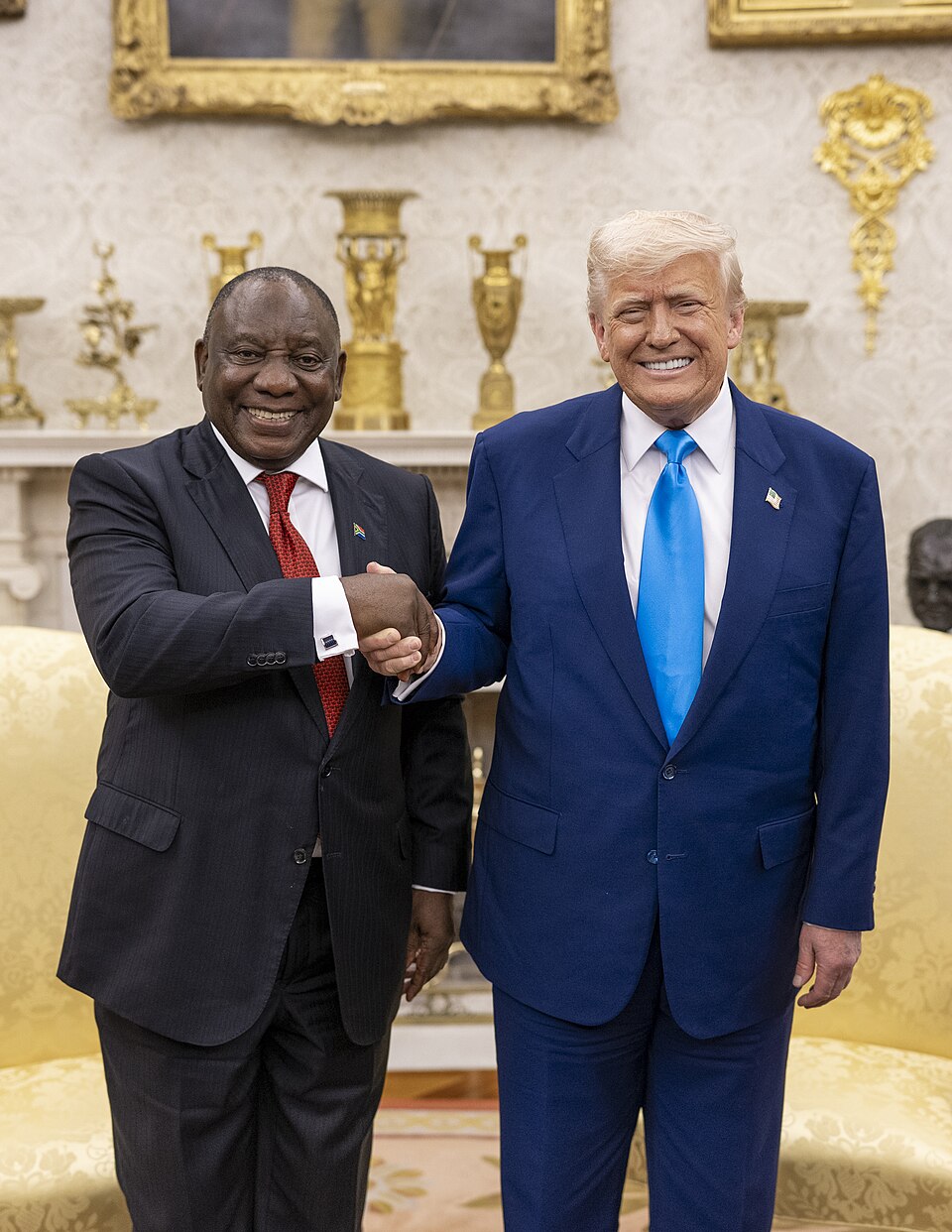
SA President Cyril Ramaphosa and US President Donald Trump: Image Supplied
By Staff Writer: Washington’s ambassador to South Africa says the future of bilateral ties now rests on Pretoria’s response to unresolved concerns ranging from rural safety to a controversial political chant.
South Africa’s relationship with the United States has entered a more confrontational phase, with US Ambassador Leo Brent Bozell signalling that Washington’s patience with Pretoria is wearing thin over a set of unresolved demands — including a call for President Cyril Ramaphosa to condemn the chant “Kill the Boer, Kill the Farmer”.
In a sharply worded interview with the SABC, Bozell said the US was not asking South Africa to overturn or disregard a Constitutional Court finding that the chant was not hate speech. Instead, he argued that Ramaphosa should publicly distance himself from what Washington views as rhetoric that could encourage violence.
“I understand what the court said. This doesn’t mean the president can’t say, look, any court in the United States makes a decision that the president can disagree with,” Bozell said.
“But it is the idea of inciting violence. The entire world sees that phrase as an incitement to violence.”
The ambassador’s intervention puts one of South Africa’s most politically sensitive debates at the centre of an already strained diplomatic relationship. The chant, associated with anti-apartheid struggle songs and frequently contested in public and legal forums, has long divided opinion in the country. While the Constitutional Court has ruled that it does not constitute hate speech in its legal context, Bozell said the United States believes the president should still condemn language it considers inflammatory.
“Our position, and we stated this to the president, is to denounce all incitements to violence,” he said.
“Find something the Boers have said and say the exact same thing about that song. We’re talking about incitements to violence.”
Bozell said the chant is among five key issues raised by Washington with the South African government in December 2025. The other concerns include the US refugee programme, expropriation without compensation, violence and safety in rural farming communities, and the ability of American companies to compete in South Africa’s economy.
According to the ambassador, two of those matters have largely moved off the immediate diplomatic agenda. He said the refugee programme was no longer a concern and that the expropriation issue was now before the courts. But he warned that the remaining questions still require action from Pretoria.
The ambassador placed particular emphasis on crime in farming areas, where he said rural residents were increasingly forced to rely on private security structures and personal firearms because of inadequate policing.
“I would say that crime in South Africa is horrific. No one’s going to disagree with me on that,” he said.
Bozell said Washington was not merely raising the issue from afar, but had offered to work with South Africa on practical rural-safety interventions. He said he had handed Ramaphosa three proposals, including one developed by the South African government, and that the US was willing to help fund initiatives aimed at protecting farming communities.
“What we’re saying, where the rural farm community is concerned, where there is so little police activity, so little. You’ve had private organisations, private individuals who have taken on the responsibility of trying to save their lives while they’re farming,” Bozell said.
His remarks come amid persistent disagreement over whether US concerns about farm violence are rooted in human-rights considerations, economic interests or strategic competition for access to South Africa’s minerals and telecommunications market.
Bozell dismissed claims that Washington’s approach was driven primarily by commercial ambitions.
“Anybody who says that ,is demagoguing this. It’s just simply not true,” he said.
Instead, he said the US wanted American firms to compete on equal terms with other international businesses, arguing that expanded investment could support job creation and economic opportunity in South Africa.
The ambassador also addressed recently announced US visa restrictions affecting certain South Africans, saying Washington would not reveal the identities of people affected by the measures.
“No. One, by law, we can’t give it. Secondly, even if we could, it’s our policy not to,” he said.
He said the list could change over time, with names potentially added or removed, making public disclosure inappropriate.
But Bozell’s most forceful message was reserved for the broader state of US-South Africa relations. He said Washington had been attempting to engage Pretoria since January 2025, but believed the South African government had failed to respond adequately to the issues raised.
“I think at this point, South Africa has to make a move on this,” he said.
“We’ve been trying since January of 2025. And every step has been taken by the United States.”
Bozell said the US still wanted a partnership with South Africa, but suggested that further talks could not substitute for concrete decisions. In his view, the five demands put forward by Washington were straightforward enough to have been resolved without prolonged diplomatic wrangling.
“The time for dialogue has ended,” Bozell said.
“These five asks were so simple. If we can’t get by something so simple, I don’t know how we can ever tackle the hard ones.”
He acknowledged that other disputes — including differing positions on Israel and broader foreign-policy questions — would require deeper and more difficult negotiations. But he maintained that the five outstanding issues should not have reached an impasse.
“We made these asks in December of 2025. Nine months later, South Africa still had not responded,” Bozell said.
“I visited with President Trump and with Secretary Rubio in Washington. They let me know unequivocally, they’ve run out of patience.”
Bozell said he carried that warning directly to Ramaphosa, informing the president that Washington expected a formal response. However, he claimed that when South Africa’s response eventually came, it did not produce the engagement the US had sought.
“When the response came, they were ignored. They were simply ignored,” he said.







