Subtotal R0,00


International/ 29 January 2025, 14:05pm/ Lijeng Moruthane
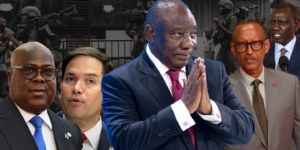
South African Government Under Pressure Amid Rising DRC Conflict: Image Supplied
By Lijeng Moruthane: A surge of diplomatic activity is underway as regional leaders scramble to contain the escalating conflict in the eastern Democratic Republic of the Congo (DRC), where fighting between the Rwanda-backed M23 rebels and Congolese forces has led to the deaths of 13 South African soldiers and wounded many more.
South African President Cyril Ramaphosa spoke with Rwandan President Paul Kagame on Monday evening, with both leaders agreeing on the urgent need for a ceasefire and the resumption of peace talks, according to a statement by the South African Presidency.
The situation for South African National Defence Force (SANDF) troops remains dire, as reports suggest they are effectively trapped in two bases—one in the regional capital of Goma and the other in the nearby town of Sake—amid intensifying clashes.
Nine South African soldiers were killed last week while attempting to prevent M23 from seizing Goma, and three more died on Monday when a mortar struck their base near Goma’s airport. Another soldier succumbed to injuries sustained earlier, raising the death toll to 13. The clashes have also claimed the lives of three Malawian and one Uruguayan soldier.
M23 rebels now appear to be in control of much of Goma, a strategically significant city. In response to the deteriorating situation, Kenyan President William Ruto has convened an emergency summit of the East African Community (EAC) for Wednesday, aiming to bring together DRC President Félix Tshisekedi and Kagame for crisis talks.
Meanwhile, the Southern African Development Community (SADC) held a virtual summit on Tuesday night, where the security organ’s troika—Tanzania, Malawi, and Zambia—deliberated on the conflict. SADC deployed its peacekeeping mission, the SADC Mission in the DRC (SAMIDRC), in December 2023 at Tshisekedi’s request to defend the country against external aggression.
Most of the SANDF and Malawian troops killed in the recent violence were part of this mission, though some South African soldiers also served under the UN peacekeeping mission, MONUSCO.
The United Nations Security Council convened an emergency session on Sunday to address the crisis. MONUSCO chief Bintou Keita urged Rwanda to withdraw its forces from the DRC and cease its support for M23. The Security Council strongly condemned M23’s offensive and called for the withdrawal of “external forces,” a clear reference to Rwanda.
The African Union’s Peace and Security Council also met virtually on Tuesday to discuss the worsening situation. South African Minister of International Relations and Cooperation Ronald Lamola condemned M23’s attacks and accused Rwanda of supporting the rebel group.
“We would also like to condemn Rwanda for its support of the M23, as clearly proven by various United Nations reports of experts,” Lamola stated. “We therefore call upon Rwanda to cease its support to the M23 and for its forces to withdraw from the DRC. The unauthorised presence of the Rwanda Defence Forces in eastern DRC is in violation of the sovereignty and territorial integrity of the DRC.”
With tensions escalating, diplomatic efforts are focusing on reviving the Luanda peace process, led by Angolan President João Lourenço. Lourenço brokered a ceasefire between Rwanda and the DRC in July 2023, but negotiations collapsed in December after Tshisekedi refused to engage with M23, insisting on talks with Rwanda instead. Rwanda, in turn, rejected this approach.
Stephanie Wolters, a senior research fellow at the South African Institute of International Affairs, expressed hope that Kagame and Tshisekedi would attend the EAC summit and agree to a ceasefire. She suggested that the United States, which maintains close ties with Ruto, might have influenced the decision to convene the summit.
However, she warned that addressing the underlying causes of the conflict—particularly the presence of the Democratic Liberation Forces of Rwanda (FDLR), a group with historical ties to the 1994 Rwandan genocide—would be challenging.
Wolters also noted that Ramaphosa’s political credibility was on the line, both internationally and domestically. “Ramaphosa has every interest in securing a ceasefire. South Africa doesn’t want to lose more soldiers, but also, this conflict impacts his political standing,” she said.
She added that Kagame likely sought to use the capture of Goma as leverage in future negotiations. “Kagame wanted to humiliate and intimidate South Africa. He wants to use Goma as a bargaining chip,” she said.