Subtotal R0,00

Agriculture/ 17 September 2024, 15:50pm/ Staff Writer
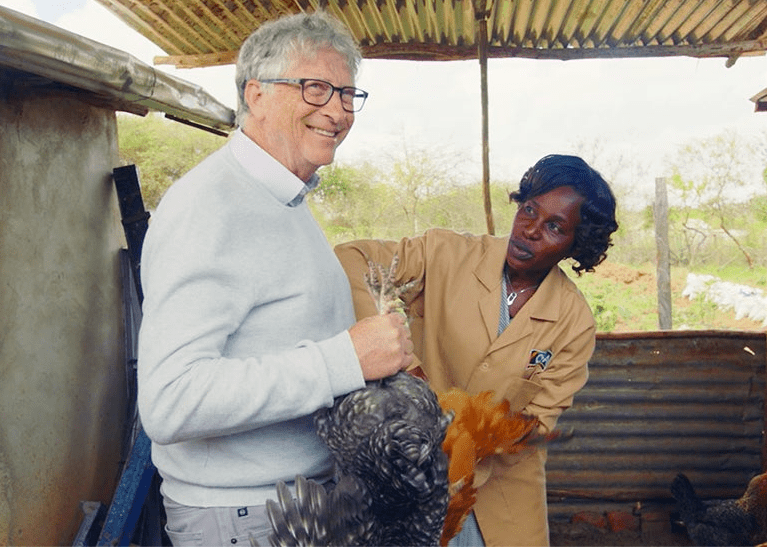
Bill Gates with farmer Mary in Kenya: Image Supplied
By Staff Writer: Africa is currently grappling with the fastest-growing population on Earth, expected to surpass 2.4 billion by 2050.
Feeding this expanding population is one of the greatest challenges for African leaders. With 10% of the continent’s current 1.5 billion people facing severe food insecurity, where entire days may pass without a proper meal, the issue is already significant.
As the population grows by another 900 million, something must change. Leaders will convene next week in Kigali for the African Food Systems Forum to debate a 10-year plan aimed at accelerating and transforming agriculture across the continent.
The main focus is on improving Africa’s 33 million smallholder farms, which produce 70% of the continent’s food but with very low yields.
The challenge is determining how to enhance these farms while ensuring the communities they support are not left vulnerable.
The debate is dominated by Bill Gates, an American software engineer and the largest owner of farmland in the U.S. Gates believes modern industrial agriculture, similar to that in the U.S., can solve Africa’s hunger crisis.
He advocates for larger farms using hybrid seeds and chemical inputs like fertilizers and pesticides, which have led to significant yields in the U.S. — maize yields average 11 tonnes per hectare there, compared to just 1.4 tonnes per hectare in Kenya.
Gates argues that for Africa to feed its growing population, it must adopt these methods.
However, implementing these strategies would require a fundamental shift in African agriculture, moving away from traditional practices.
In 2006, the Gates Foundation and the Rockefeller Foundation established the Alliance for a Green Revolution in Africa (Agra) to promote such changes.
Despite more than a billion dollars invested in reshaping agricultural policies, the results have not been as expected.
A recent report by the African Centre for Biodiversity focused on Zambia, a country facing one of its worst droughts.
Nearly half of the maize crop has been lost, with food prices surging by 30%, leaving over six million Zambians at risk of food shortages. Zambia, one of Agra’s success stories, implemented a subsidy program in 2009 that pushed farmers toward commercial seeds and fertilizers.
Yet, the report concludes that instead of increasing yields, the approach has made farmers more vulnerable to climate change. The use of hybrid seeds and fertilizers has degraded the soil, while the shift to cash crops has left many farmers hungry.
“We used to grow diverse crops,” said Zambian farmer Mary Sakala, chairperson of the Rural Women’s Assembly. “But now governments and agribusiness have pushed farmers into monoculture that depends on inputs. Their programs have made us all vulnerable.”
Zambia’s situation is not unique. Broader studies have questioned the effectiveness of Agra’s policies, including one commissioned by the Gates Foundation, which found that Agra did not meet its goal of improving the incomes and food security of 9 million smallholders.
A separate Tufts University study found no evidence of positive impacts on crop yields or food security in the 13 countries targeted by Agra.
In response, Agra dropped “Green Revolution” from its name in 2022, although it remains committed to its industrial agriculture approach.
Critics like Bishop Takalani Mufamadi, speaking on behalf of the Southern African Faith Communities’ Environment Institute, argue that Gates and large agribusinesses are “playing God.”
He believes their industrial approach “degrades soils, destroys biodiversity, and values corporate profit over people.”
He called for reparations to repair the damage done, while Million Belay, general coordinator of the Alliance for Food Sovereignty in Africa, warned that reliance on agrichemicals leaves farmers vulnerable to extreme weather and price fluctuations.
He further criticized Gates’ influence over African policies, saying, “The path they are leading us on is a kind of agriculture where we cannot farm without the use of agrichemicals.”
The Gates Foundation has dismissed these critiques, maintaining that their efforts support countries in achieving agricultural development strategies aligned with national plans.
Enock Chikava, the Gates Foundation’s director of agricultural delivery systems, stated that they are committed to engaging in dialogue with African voices, including farmers, to address food security.
However, groups like the Alliance for Food Sovereignty in Africa, which claims to represent over 200 million smallholder farmers, will not be part of the upcoming forum in Kigali.
Instead, it seems that Bill Gates’ vision for Africa’s agricultural future will continue to influence policy across the continent for the foreseeable future, regardless of whether it succeeds.