Subtotal R0,00

International News/ 16 September 2024, 15:00pm/ Lijeng Moruthane
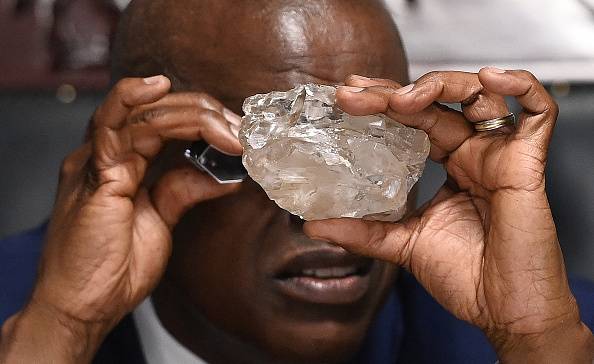
Botswana’s President Mokgweetsi Masisi looks at a large diamond discovered in Botswana: Image Supplied
By Lijeng Moruthane: Since 1967, Botswana’s presidents have used diamond revenues to fund infrastructure projects, a tradition President Mokgweetsi Masisi continued last month when he revealed the largest diamond discovered this century.
“I can see new roads being built,” Masisi exclaimed upon showcasing the gem, which is the size of an adult’s palm. This diamond, the second-largest ever found, could fetch tens of millions of dollars, with Botswana claiming 10% of the proceeds.
Unlike many resource-rich nations, Botswana has secured a stake in diamond sales through favorable agreements with mining companies.
However, Masisi faces growing challenges in maintaining diamond revenue. Botswana, the world’s top producer of diamonds by value and accounting for 20% of the global diamond output by weight, is now contending with the rise of lab-grown diamonds, which are cheaper and nearly indistinguishable from mined ones.
Earlier this year, the country’s economic growth projection of 4.2% plummeted after diamond sales dropped by nearly half in the first quarter.
The International Monetary Fund (IMF) revised its forecast, predicting just 1% growth and recommending Botswana cut back on infrastructure spending due to reduced revenues.
To adapt, Botswana has revamped its diamond marketing strategy, highlighting significant discoveries to generate international attention.
The Karowe mine, operated by Canadian miner Lucara Diamond, has been pivotal in these efforts. Located 500 km from Gaborone, it has produced several massive diamonds, including a 2,492-carat gem unearthed last month using advanced X-ray technology.
However, mining historian Duncan Money points out that while rare stones attract attention, they cannot sustain an entire industry. “Ultimately, it doesn’t change the fact that synthetic diamonds are becoming cheaper and better,” he noted.
Faced with declining returns, Masisi has sought to negotiate better deals. In February, he threatened to end Botswana’s longstanding partnership with Anglo American, co-owners of the mining company De Beers alongside Botswana’s Debswana.
Critics accused him of resorting to nationalism, but when the Debswana agreement was renewed in principle, the country secured better terms.
Previously, Debswana sold only 25% of its diamonds to the state-owned Okavango Diamond Company; that share will increase to 30%, eventually reaching 50% over the next decade. De Beers, in which Botswana holds a 15% stake, will continue to receive the rest.
Additionally, De Beers committed to investing a billion pula ($75 million) in a development fund, set to expand to 10 billion pula over ten years.
Botswana’s strategy to safeguard its diamond revenue includes blocking external investors.
In May, after Anglo American’s announcement of its split from De Beers, Masisi declared Botswana’s willingness to increase its stake in the offshoot to prevent “bad guys” with “impatient capital” from gaining influence.
Though De Beers posted a modest $72 million in profit last year, its historical earnings have ranged from $500 million to $1.5 billion.
By 2028, the company aims to restore its annual core profit to $1.5 billion. Masisi believes that by investing public funds to weather the volatile diamond market, Botswana can continue to finance vital infrastructure projects.
Yet others, like Duncan Money, argue that the country should focus on diversifying its economy.