
Subtotal R0,00

KwaZulu-Natal/08 October 2026, 04:36am/ Staff Writer
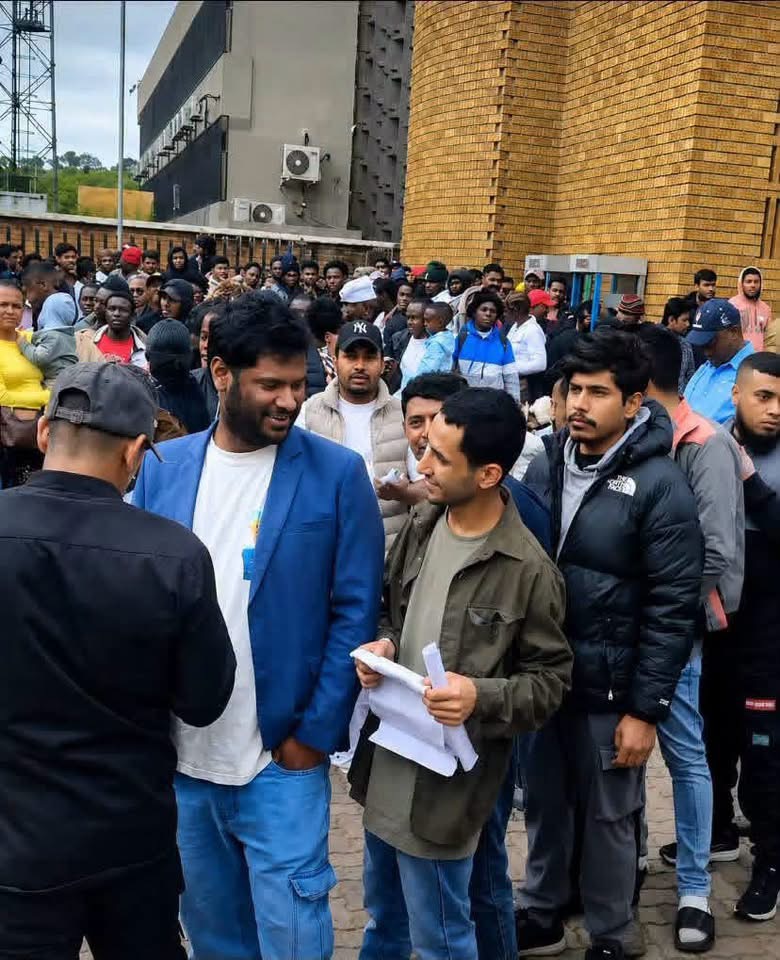
By Staff Writer: A tense standoff outside the Che Guevara Road Home Affairs Refugee Reception Centre on Wednesday has thrust South Africa’s fraught immigration debate back into the national spotlight, raising sharp questions about who gets access to state services — and where the line lies between public protest and the rights of vulnerable asylum seekers.
Thousands of asylum seekers were dispersed from the centre after demonstrators blocked its entrance and declared that no foreigners would be allowed to enter. The action was led by members of the anti-illegal migration group March and March, who confronted undocumented foreign nationals and accused them of exploiting South Africa’s Constitution to remain in the country.
At the heart of the confrontation is a collision of competing claims: activists demanding stricter immigration enforcement and faster processing of alleged abuse in the refugee system, and legal experts warning that lawful asylum seekers cannot be denied protection or access to services.
March and March leader Jacinta Ngobese-Zuma said the country’s refugee system was being manipulated.
“Our refugee system is being abused. We know that. We have seen it several times,” she said.
Ngobese-Zuma argued that the state should distinguish between legitimate refugees and people whom she believes do not qualify for protection.
“And you can’t keep labelling everyone as a refugee. They should send them back at the border,” Ngobese-Zuma said.
She said the Department of Home Affairs should direct its attention towards tackling administrative delays and verifying refugee claims rather than allowing people whom she described as economic migrants to enter the system.
“Home Affairs has a backlog, and what they should be doing is identifying real refugees instead of those who are coming to the country to open tuckshops, spaza shops and be economic migrants,” she said.
But political analyst Zweli Ndevu said the dramatic scenes at the centre highlighted a constitutional dilemma. While South Africans are entitled to protest and challenge government failures, he said those rights cannot be used to obstruct other people from receiving services to which they are legally entitled.
“I think people have a right to protest, and people have a right to voice their dissatisfaction with how services are delivered by government. So it is a constitutional right that is entrenched in the Constitution, and people have a right to exercise that,” Ndevu said.
Ndevu said the state must step in when demonstrations stop vulnerable people from accessing essential services.
“But once that right infringes on other people’s right to get services, then it becomes a problem. That’s where you want government to intervene, to be able to protect those who are vulnerable, whose rights are infringed,” he said.
He added that asylum seekers who comply with South African law should receive protection from the state, regardless of the broader political anger surrounding migration.
“In this case, the asylum seekers, when they are subjecting themselves to the law of the country, they should be protected by the state. So it is important for the state to protect them,” Ndevu said.
The protest also drew strong comments from SA First Forum leader Xolani Zuma, who is Ngobese-Zuma’s husband. He described the situation as evidence that government was prioritising foreign nationals while many South Africans faced unemployment, inadequate education and limited economic prospects.
“The situation for me is a very sad situation for South Africans. Their own government is focusing its own energies and resources on funding foreign nationals who pretend as though they are refugees. Some of them genuinely are refugees, but some of them, and many of them, many, many of them, are economic migrants,” Zuma said.
Zuma cited unemployment and educational exclusion as urgent crises requiring greater government focus.
“Over four million South Africans don’t have any education. They have never been employed. Over 47% of young people are unemployed in this country,” he said.
He dismissed the scale of the refugee challenge as overstated and urged citizens to place pressure on government over its priorities.
“Yet government resources are being injected and thrown into this so-called crisis of refugees that is non-existent. All we are saying is that we would be taking government in part in respect of the four million citizens. But we are calling on all South Africans to take this thing quite seriously,” Zuma said.
Zuma said voters ultimately held the power to decide whether they accepted the country’s current direction.
“They must decide whether they still want to be governed in this manner. And it’s their right, at the end of the day, as enshrined in the Constitution, to decide what kind of leadership they want, to decide who is going to lead them, to decide how they are going to do that, how this Constitution is going to lead, and the right of the person to exercise. But this is not normal,” he said.







