
Subtotal R0,00

News/04 April 2026, 08:21am/Dakalo Mulaudzi
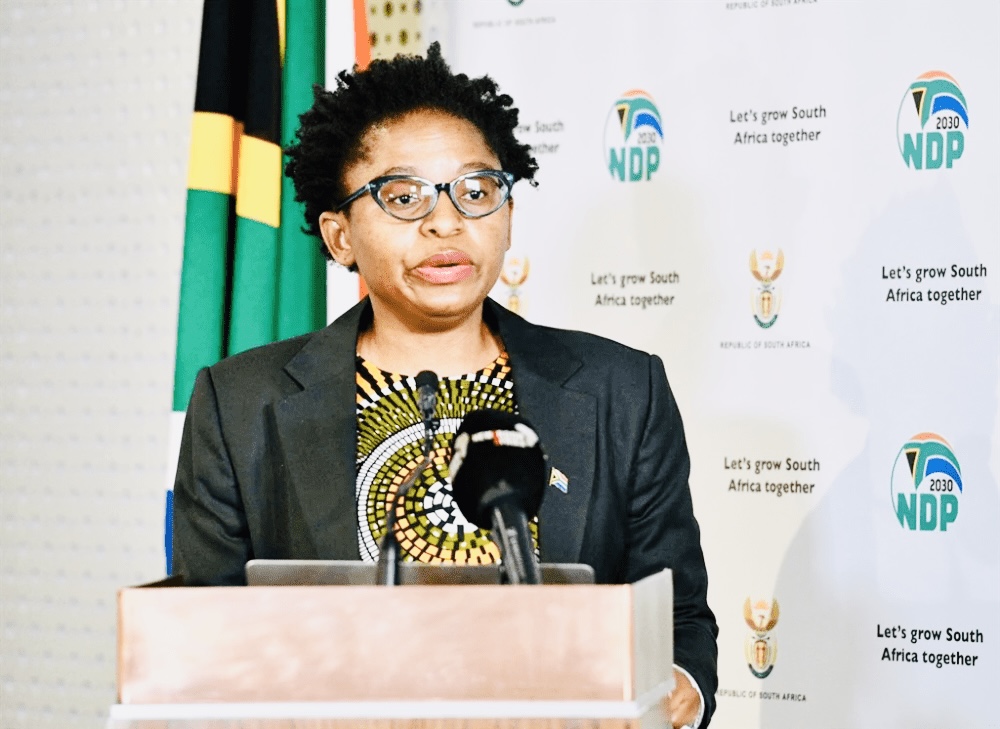
Minister in the Presidency Khumbudzo Ntshavheni: Image Supplied
By Dakalo Mulaudzi: A political storm over migration policy and cultural sovereignty erupted this week as Cabinet backed sweeping changes to South Africa’s refugee and citizenship regime while simultaneously lashing out at the failed attempt to crown an Igbo “king” in the Eastern Cape.
Minister in the Presidency Khumbudzo Ntshavheni used Thursday’s media briefing to deliver a blunt message on both fronts: South Africa intends to tighten its immigration framework, and it will not tolerate actions that undermine local law, custom or public order.
The briefing followed a two-day Cabinet meeting where ministers approved a revised white paper on Citizenship, Immigration and Refugee Protection (CIRP), a policy document that could dramatically reshape how refugee status, visas, immigration controls and citizenship are handled in the country.
The white paper, first published for public comment in December 2025 by the Department of Home Affairs, proposes consolidating the Citizenship Act, Immigration Act and Refugees Act into one legal framework.
According to government, the plan is to remove contradictions in the current laws, improve implementation and push immigration systems further into digital administration.
Yet it was Ntshavheni’s explanation of the refugee proposals that drew the sharpest attention.
South Africa, she said, is looking more closely at who should qualify for protection and under what circumstances, especially through the application of the “first country of safety” principle.
“You’ll recall that South Africa does not provide refugee camps,” the minister remarked.
She said the country instead absorbs refugees and asylum seekers into society, allowing them to work and live among communities, provided they are documented.
“The first country of safety principle is guided by the UN. It states that in situations of conflict, people are allowed to leave their countries and go to the next country where there is no conflict, where they can be granted refugee status and protection.
“Even if they arrive without proof of identification, they must be registered, accommodated, and given some level of recognition.
“Why? Because sometimes they have to flee when there’s an attack with nothing but the clothes on their backs – and that is important,” Ntshavheni told reporters.
But she also made it clear that Cabinet believes South Africa should not automatically become the end destination for people passing through multiple peaceful countries.
“There’s no war in Botswana. There’s no war in Lesotho. There’s no war in Zimbabwe. There’s no war in Namibia.
“There’s no war in Mozambique. Even if you go slightly further, there’s no war in Zambia. There’s no war in Malawi.”
The revised policy also opens the door to reserving certain parts of the economy for South African citizens, even as it continues to recognise the right of asylum seekers to work and support themselves.
Government says the wider package will incorporate visa reform proposals from Operation Vulindlela, improve implementation failures and speed up digital transformation across the immigration system.
Ntshavheni also referenced South Africa’s earlier response to Zimbabwe’s economic collapse and prolonged drought, arguing that the country had shown compassion before, but could not avoid re-examining whether old exceptions still make sense.
“You’ll remember when Zimbabwe had an economic meltdown and the period of extended drought periods, we admitted people as economic refugees at the time when we introduced the Zimbabwean special permit.
“We admitted them because it’s inhumane to sit in your country and allow your neighbors to die when you can assist.
“But the question that we have is that does the economic situation still warrant economic migrants in the country? So the white paper deals with those issues.
“I don’t want to say who doesn’t qualify to be here because of that definition, because you then say Minister Ntshavheni is mobilising against this grouping, that grouping, and then I’ll be accused of xenophobia.”
The same Cabinet briefing, however, was dominated by outrage over events in KuGompo City, where the attempted coronation of an Igbo “king” sparked protests that later turned violent. Cabinet strongly condemned the incident, dismissing the effort as both unlawful and absurd.
Ministers said they were disgusted by the conduct of Nigerians involved in the event, branding the attempted installation a “kindergarten gimmick.”
Ntshavheni said Cabinet had noted an apology from the Nigerian High Commission and added that the behaviour of some Nigerian citizens had been unbecoming of “visitors” in South Africa.
She stressed that the matter touched a nerve because of the country’s cultural traditions and legal protections around traditional leadership.
“Cabinet confirmed that the establishment, recognition, and functioning of any traditional leadership structure are strictly governed by the Traditional and Khoi-San Leadership Act, which provides clear and non-negotiable procedures for legitimacy and recognition.”
Cabinet, she said, had therefore dismissed the attempted coronation outright, insisting it carried no legal effect.
At the same time, the minister said the violent turn taken by Monday’s protest could not be ignored.
Ntshavheni added that it was deeply concerning that Monday’s protest of legitimate grievances, had resulted in violence and criminality, and Cabinet has reminded citizens to protest in line with the law.
Even so, she moved to contain any diplomatic fallout, saying relations between Pretoria and Abuja remain solid and that many Nigerians in South Africa are law-abiding.







