
Subtotal R0,00

News/15 March 2026, 15:14pm/Mpho Mokoena
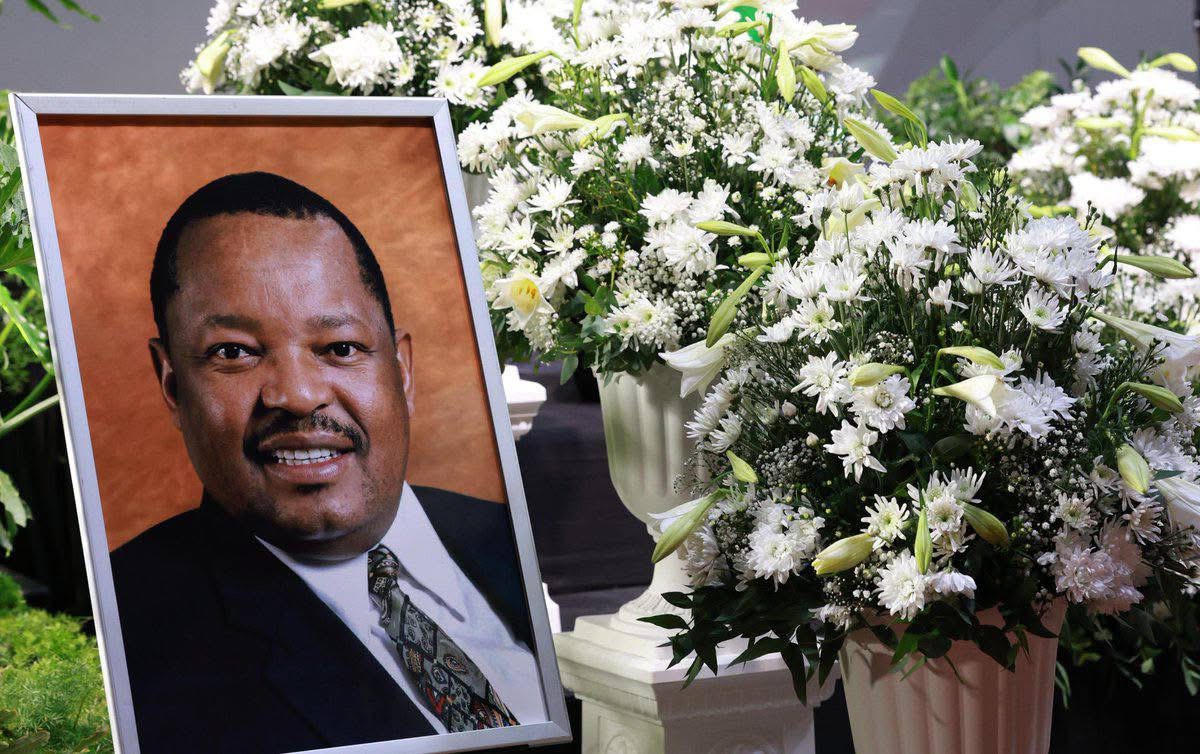
Freedom Fighter Mosiuoa Lekota Laid to Rest: Image Supplied
By Mpho Mokoena: Bloemfontein was wrapped in grief and reflection on Saturday as political leaders, family, comrades and mourners gathered to lay anti-apartheid veteran Mosiuoa Lekota to rest, with tributes focusing not only on his long public life but also on the enduring meaning of the freedom he helped win.
Rather than marking only the passing of a senior political figure, the funeral became a broader call for South Africans to examine whether the democratic ideals Lekota fought for are still being defended with enough honesty, courage and urgency.
Delivering the eulogy, Deputy President Paul Mashatile placed Lekota at the centre of South Africa’s liberation history, saying his life cut across defining eras of resistance and democratic transition.
“Today we gather as a nation united in grief, remembrance and gratitude to bid farewell to a towering figure of our liberation struggle and the democratic state,” Mashatile said.
Mashatile traced Lekota’s political path from the rise of black consciousness to activism in the United Democratic Front (UDF), later leadership in the ANC and eventually the founding of the Congress of the People (Cope). In doing so, he presented Lekota as a man shaped by struggle, but equally by principle.
“His life was lived in pursuit of a better South Africa, marked always by honesty, integrity and courage,” Mashatile said.
In one of the strongest themes of the day, Mashatile said Lekota understood that leaders come and go, but the values they are meant to serve must outlive them.
Lekota understood that leaders are transient “but the congress, as an ideal of unity and justice, is eternal. He knew that the measure of a leader is not how long he holds office, but how faithfully he serves the covenant of congress…”
Mashatile added that Lekota never abandoned that conviction, even as politics shifted around him.
Lekota carried that torch with unyielding fidelity. “He stood as proof that while names may fade from ballots, the congress ideal remains a beacon of unity, a compass of justice and hope for the people.”
The deputy president said Lekota viewed leadership as service rather than status, and democracy as something practical that must improve ordinary lives.
“For him, democracy was never a distant set of rules; it was a living instrument to transform the lives of ordinary people.
“He dedicated himself to ensuring that the Constitution became a shield for the vulnerable and a bridge across the chasm of inequality.”
Lekota’s political activism began in the 1970s through the South African Students’ Organisation, where he worked with leaders including Steve Biko and Barney Pityana in advancing black consciousness politics. Mashatile said prison only hardened his resolve.
“His imprisonment on Robben Island, alongside former president Nelson Mandela, deepened his conviction that freedom was non-negotiable. From his youth through the UDF, the infamous treason trial of Delmas and into government, his journey was marked by sacrifice and service.”
Speakers at the funeral also highlighted Lekota’s role in building democratic institutions after apartheid. As the first premier of the Free State, Mashatile said, he inherited a deeply divided province and helped establish a new administration.
As the first premier of the Free State, he stepped into a province “scarred by apartheid and laid the foundation of a united, non-racial government.
“He was instrumental in forming the provincial administration and embarking on a long journey to build a government that served all citizens.”
Lekota later served as chairperson of the National Council of Provinces and minister of defence under former president Thabo Mbeki. Mashatile said even in that portfolio, Lekota remained committed to democratic rather than militaristic values.
He later served as chairperson of the National Council of Provinces (NCOP) and as minister of defence under former president Thabo Mbeki, where he “carried the burden of leadership with dignity.
“He envisioned a defence force, not as an instrument of repression, but as a guardian of democracy and peace – a vision that continues to guide us even today.
“In guiding the defence force, Lekota ensured that the instruments of war became guardians of peace, transforming them into protectors of democracy, still in its infancy.
His vision was clear, Mashatile said, that the strength of a nation lies not in its weapons, but in its ability to reconcile and to heal.
That message of reconciliation ran powerfully through the service. Mashatile said Lekota saw healing not as weakness, but as one of the country’s most important acts of political courage.
“He strongly believed that reconciliation was not weakness but strength. Peace was not the absence of struggle but the triumph of justice.
“He reminded us that democracy is not a gift, but a responsibility; a constant refrain that challenges each generation to guard and nurture it.”
Mashatile also recalled Lekota’s discipline and seriousness during the turbulent years of student activism, describing him as a calm but firm organiser.
“He would arrive at meetings with nothing but a notebook in his hand and conviction in his voice. He would listen carefully, then rise with calm authority and remind everyone that our struggle is not for ourselves; it is for the generations to come.”
According to Mashatile, Lekota remained committed throughout his life to a South Africa that is “non-racial, non-sexist, democratic and united”, while holding firmly to the principles of the Freedom Charter.
“He held steadfast to the ideals of the ANC, Bill of Rights and the 1955 Freedom Charter that South Africa belongs to all who live in it black and white.”
He said Lekota was also respected for his ability to work across political divisions, refusing to be consumed by factionalism or personal ambition.
“In moments of heated debate, he was never swayed by partisanship or personal gain. Instead he returned again and again to the charter’s call for unity, equality and shared belonging.”
That quality, Mashatile said, made Lekota both a constitutionalist and a reconciler. He was “a leader who could listen and reason and who could remind us that our democracy is strongest when it embraces diversity of thought while holding fast to the principles that unite us”.
With Lekota’s death coming during Human Rights Month and just ahead of the 30th anniversary of the Constitution, Mashatile used the moment to challenge the country to reflect on the gap between democratic promises and lived reality.
“His passing compels us to ask ourselves whether we are living up to the promise of the rights and freedoms for which he laboured.”
Mashatile said the question cannot be answered through symbolism alone.
“It is a question that causes us to measure our progress, not by ceremony and speeches alone, but by the lived reality of dignity, equality and justice in the daily lives of our citizens.”
While acknowledging democratic gains since 1994, he said South Africa still faces painful failures, especially unemployment, inequality and gender-based violence.
“Indeed, we have walked far since 1994 but we cannot yet claim to have arrived. How can we say we have arrived when there is a child who has met every requirement for a degree but still stands on the verge of opportunity with no employment? How can we say we have arrived when there is gender-based violence that remains one of South Africa’s most devastating and persistent human rights violations?”
He added: “Progress without opportunity is incomplete, freedom without dignity is unfinished and justice without inclusion is unfulfilled.”
Mashatile credited Lekota with helping shape the democratic gains many South Africans now regard as ordinary but which were won through sacrifice.
“His hand is evident in the triumph of universal suffrage; in the expansion of housing and healthcare; in the opening of classrooms and the provision of social grants. These achievements are the bricks and mortar of dignity and the lifelines of hope for our people.”
He described Lekota as a leader whose credibility rested not on rank, but on character.
Lekota was a leader “whose moral authority flowed not from office but from service. Not from title but from trust. Not from privilege; but from the people.
“His life reminds us that true leadership is not measured by titles but by values upheld and trust earned.”
Mashatile said Lekota never separated political freedom from economic justice and remained committed to opportunities for the poor and the young.
“In all his endeavours, he was determined to create opportunities for every child to learn, for every worker to earn a decent living and for every family to live with dignity.
“He believed that education was the key for breaking the cycle of poverty, that skills development was the bridge to employment and that empowering the youth was the surest way to secure their future.”
He also remembered Lekota as a politician who was prepared to speak uncomfortable truths, even at personal cost.
“Lekota was a man who told the truth, even when it was uncomfortable. He did not chase popular acclaim; he chased justice. His integrity was not for sale, nor was his commitment to the downtrodden found wavering.”
Mashatile said Lekota repeatedly warned of the dangers corruption, inequality and unemployment pose to democracy.
“He was clear that corruption robs the poor, inequality divides the nation and unemployment steals hope.
“He challenged us to confront these realities with honesty and courage and to govern not for ourselves but for the millions who look to democracy as a promise of a better life.”
As he brought his eulogy to a close, Mashatile returned to what he called Lekota’s deepest contribution: his belief that reconciliation was essential if South Africa was to truly heal from apartheid.
“Perhaps, his most profound contribution was his belief that a nation divided by the atrocities of apartheid could not prosper without profound healing. He understood that wounds of our past were deep emotional, psychological and physical yet he believed in the power of reconciliation, not as forgetting but as facing the truth to lance the boil of hatred.”
He said that though Lekota’s death leaves a major absence, his contribution would continue to inspire future generations.
“While his departure leaves a void, his legacy as a committed freedom fighter who sacrificed his own freedom for ours will never be forgotten.”
The ANC echoed that message, saying South Africa has a duty to ensure Lekota’s role in the liberation struggle is never erased. ANC secretary-general Fikile Mbalula, speaking at the funeral, said his life would remain part of the country’s permanent historical memory.
“Your journey among us has come to its early end, but your contribution to the freedom of this nation will remain written in the history of our people. May your spirit rest in eternal peace and may the flame of your memory continue to guard the path of freedom,” Mbalula said.
Lekota, Cope leader and co-founder, died last week after a prolonged illness. He was among the many Robben Island political prisoners who gave up their freedom in the fight against racial oppression and apartheid rule.
By the end of Saturday’s funeral, the mood in Bloemfontein was one of sorrow, but also challenge: that remembering Lekota must mean more than praise. It must mean defending the democratic, non-racial and just South Africa for which he lived and fought.







