
Subtotal R0,00

News/11 February 2026, 09:03am/ Dakalo Mulaudzi
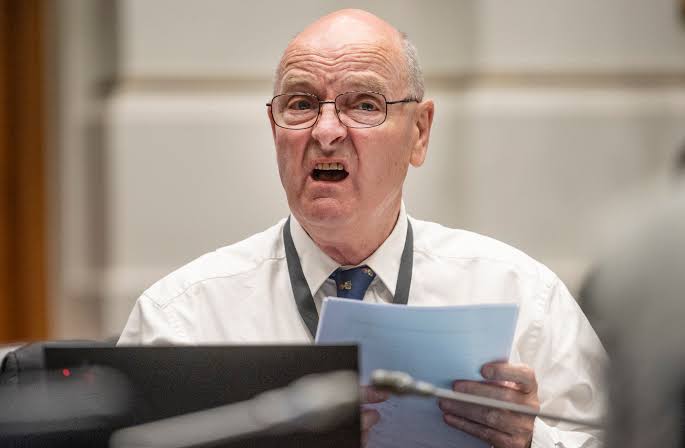
Paul O’Sullivan: Image Supplied
By Dakalo Mulaudzi: Former police reservist Paul O’Sullivan delivered a blistering account to Parliament’s ad hoc committee probing alleged interference, corruption and misconduct within the South African Police Service (SAPS) and the broader law enforcement apparatus, alleging that the country’s top cop once sat in two seats at once — and that the fallout shook policing and justice during the Mbeki-Zuma power struggle.
At the centre of O’Sullivan’s testimony was former national police commissioner Jackie Selebi, whom he accused of violating the South African Police Service Act by remaining an active senior African National Congress (ANC) politician while leading the police.
“Part of the problem is the Police Service Act makes it clear that no police official may be an active politician. At the time Jackie Selebi was the commissioner of the police, he was also a member of the National Executive Committee of the ANC. So now suddenly the rules of the Police Service Act were being flouted,” O’Sullivan said.
O’Sullivan told MPs the so-called “spy tapes” illuminated how political and prosecutorial currents allegedly moved beneath the surface, particularly as rivalry between former president Thabo Mbeki and Jacob Zuma intensified ahead of the ANC’s decisive 2007 Polokwane conference.
“Not only that. You have heard of the so-called spy tapes. The spy tapes make it clear that there was a concerted effort on the part of certain persons, one of them being the then head of the Scorpions, a chap by the name of Leonard McCarthy,” O’Sullivan said.
He described a period between 2005 and 2008 as fertile ground for interference — with investigations and prosecutions allegedly marshalled in the political contest over Zuma’s ascent.
The recordings later became central to legal challenges involving Zuma, who argued that political interference tainted the timing of corruption charges against him.
The tapes were cited when charges were controversially withdrawn in 2009, shortly before Zuma was sworn in as president — a move later overturned by the courts.
At the time, acting National Director of Public Prosecutions Mokotedi Mpshe said the recordings indicated a political conspiracy against Zuma, rendering the prosecution untenable.
O’Sullivan told the committee the recordings included coded exchanges that, in his view, revealed an agenda aimed at rescuing Selebi while tightening the net around Zuma.
“The spy tapes show his conversation with a person by the name of Andre Pienaar who is based in London. They used code words, but it demonstrated their plan to get Selebi off the hook and get Zuma on a hook.”
O’Sullivan said the tapes also captured hostility toward him personally, portraying him as an obstacle to be removed.
“In the process, the problem that they had was this individual by the name of O’Sullivan. In those spy tapes, it is stated categorically, ‘Let us not worry about O’Sullivan, we will bring somebody in that will deal with him decisively.’ I felt that I did the right thing,” he said.
He insisted his work was driven by principle — not faction.
“I had carried out the investigation which triggered the production of the evidence which led to Jackie Selebi being arrested and charged. I had started the work which became the catalyst for the criminal charges which he faced,” he said.
“I wanted to live in a country where there is the rule of law. I didn’t want to live in a country where a chief of police could be so corrupt that he could enter into an agreement that could assist a sitting president to arrest and charge a future possible president.”
“At the time I didn’t know who was to become president. I didn’t know Jacob Zuma from a bar of soap,” he added.
Selebi was convicted of corruption in 2010 and sentenced to 15 years’ imprisonment after being found guilty of receiving payments from convicted drug trafficker Glen Agliotti. He later died in 2015 after being released on medical parole.
O’Sullivan also outlined his involvement in investigations that led to the seizure of drugs valued at about R200 million and the arrest of Agliotti, whose prosecution became central to the case against Selebi.
After Agliotti’s arrest, several individuals linked to the drug trafficker entered plea agreements with prosecutors, disclosing evidence of payments allegedly made to Selebi — evidence later presented during the trial.







