Subtotal R0,00

News/ 04 November 2025, 06:40am/ Mpho Mokoena
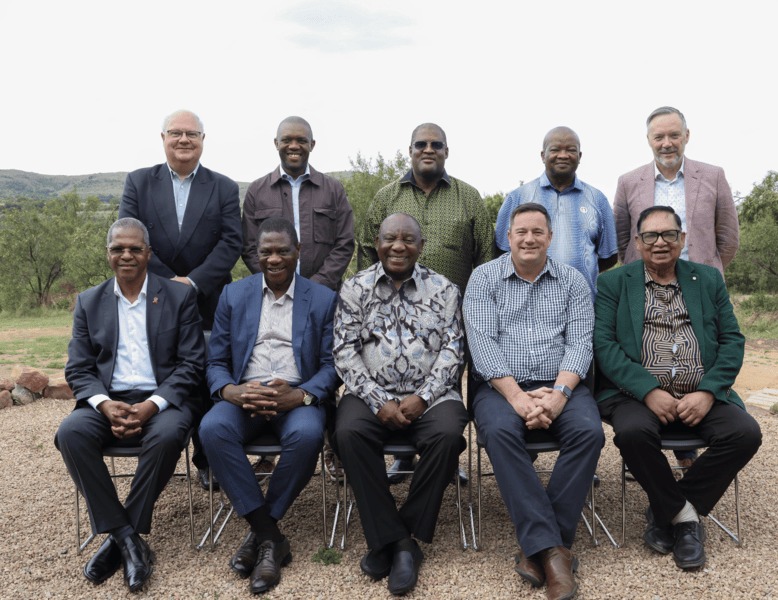
GNU Leaders Promise Urgent Action on Poverty and Economic Growth. Image Supplied
By Mpho Mokoena: The leaders of South Africa’s Government of National Unity (GNU) have wrapped up what insiders described as a “highly guarded” two-day retreat at the Cradle of Humankind, where President Cyril Ramaphosa called for renewed cooperation and urgency in addressing the country’s most pressing challenges — from unemployment and poverty to crime, corruption, and service delivery failures.
The retreat, attended by 10 political party leaders, concluded on Monday in Gauteng and aimed to evaluate the GNU’s progress 16 months after its formation, review the implementation of key priorities, and iron out tensions that have occasionally tested the coalition’s cohesion.
Although the Presidency framed the meeting as a “strategic reflection session,” its secrecy fuelled speculation that the GNU was working to quell emerging divisions, particularly after disputes over the 2025 national budget. The Democratic Alliance (DA), one of the largest parties in the coalition, initially opposed the budget before eventually supporting it — a sign of underlying strain within the unity government.
Yet, in a joint statement, the leaders — including Ramaphosa and his deputy, Paul Mashatile (ANC), DA leader John Steenhuisen, IFP’s Velenkosini Hlabisa, Patriotic Alliance’s Gayton McKenzie, and others — declared that the GNU “remains united and strong.”
“The meeting agreed that this forum of party leaders would meet regularly to provide strategic political direction to the work of the GNU,” the statement read.
The leaders’ reaffirmation of unity came at a time when the GNU faces growing public scrutiny. Many South Africans have expressed doubt about whether the multi-party government — an unprecedented experiment in the country’s democratic history — can deliver tangible improvements in the face of economic stagnation and widespread service delivery breakdowns.
To counter that perception, Ramaphosa emphasized that the GNU’s focus remains squarely on action. According to the Presidency, the coalition has already introduced key reforms in energy, logistics, telecommunications, water, and visas to drive inclusive growth and job creation.
It also launched infrastructure maintenance programmes, expanded early childhood development, and implemented public employment initiatives to provide “unprecedented work and livelihood opportunities” for young people.
Despite these achievements, internal disagreements have been unavoidable. The leaders acknowledged that disputes over fiscal priorities — particularly the DA’s resistance to aspects of the national budget — tested the GNU’s mechanisms for consultation and consensus.
However, they described the episode as a “learning curve,” vowing to strengthen coordination between the parties on fiscal and policy planning.
“The GNU has drawn important lessons from these experiences and will ensure more effective consultation in developing fiscal priorities,” the joint statement noted.
To that end, the meeting ratified the GNU Clearing House Mechanism, a working group designed to handle policy disagreements before they escalate into public disputes. Leaders said the mechanism would be crucial to ensuring the GNU functions “optimally and in line with the Statement of Intent.”
The retreat also reviewed ongoing reforms to rebuild public institutions and law enforcement agencies weakened by years of corruption and state capture.
According to the statement, the GNU has “maintained macroeconomic stability, achieved a primary budget surplus, and pursued a responsible fiscal path,” while channelling funds toward productive investments.
Leaders pointed to progress in legislative reforms and investigations led by the Special Investigating Unit (SIU), claiming that these efforts have strengthened South Africa’s capacity to fight corruption and serious crime. They also reaffirmed the goal of removing the country from the Financial Action Task Force (FATF) grey list, which has hurt investor confidence.
The GNU leaders said the next phase of the administration’s five-year Medium Term Development Plan will focus on practical interventions to ease the cost of living, professionalise the public service, and tackle hunger.
They agreed to accelerate a national food security plan, expand skills development and youth employment programmes, and deploy law enforcement resources to combat gangsterism and organised crime.
Municipal accountability also featured prominently. The leaders committed to ensuring that national and provincial governments intervene more decisively when municipalities fail to deliver essential services — a move aimed at restoring public confidence in local governance.
On the international front, the GNU pledged to strengthen South Africa’s role as a regional stabiliser and “constructive player” in global peacekeeping and diplomacy. With the country set to assume the G20 presidency under the theme “Solidarity, Equality, Sustainability,” the leaders said they intend to promote a “people-centred and inclusive” development agenda.
Finance Minister Enoch Godongwana briefed the meeting on South Africa’s fiscal outlook, warning that the country’s fragile economic recovery requires disciplined management. The leaders agreed that the government must act with “greater urgency” to ensure that progress made on paper translates into improvements felt in households across the country.
For now, the GNU’s challenge lies in balancing stability with delivery. Its unity message, while strong on paper, will be tested in the months ahead as it faces ongoing economic strain, political differences, and public impatience for visible results.
Still, as the leaders concluded their retreat, they sought to project confidence and continuity:
“The GNU is focused on urgency and action,” their statement declared. “It remains true to its fundamental purpose — to serve the interests and meet the needs of all South Africans.”