Subtotal R0,00

Politics/ 30 October 2025, 09:15am/ Mpho Mokoena
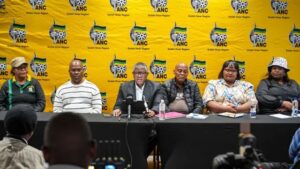
ANC Secretary-General Fikile Mbalula spoke to the media in Cape Town on 29 October 2025, following a meeting with the party’s Western Cape leadership. Image Supplied
By Mpho Mokoena: The African National Congress (ANC) has announced that its newly established Provincial Task Team (PTT) in the Western Cape will immediately begin working to strengthen the party’s structures and rebuild voter confidence in the province. The move comes as part of the ANC’s broader national strategy to rejuvenate its provincial leadership following disappointing results in the 2024 general elections.
On Wednesday, the ANC dissolved its Western Cape Provincial Executive Committee (PEC) and replaced it with the task team — the third provincial structure to undergo reconfiguration since the elections. The decision follows similar interventions in other provinces where the party’s performance fell below expectations.
Despite holding national power, the ANC has struggled to regain control of the Western Cape since losing the province to the Democratic Alliance (DA) in 2009. The DA has since consolidated its position in the province, maintaining governance across key municipalities and strengthening its voter base.
Speaking at a media briefing in Cape Town after meeting with the provincial leadership, ANC Secretary-General Fikile Mbalula said the task team’s establishment marked a crucial step in reviving the party’s fortunes in the province. He emphasized that the new leadership would not spend time theorizing or debating future plans but rather focus on immediate implementation.
“It’s not to theorise about what you’re about to do or what you will look like after the reconfiguration. It’s how you execute the task assigned to you by the national executive committee,” said Mbalula. “So, we have reinforced the leadership here.”
The newly appointed convenor of the task team is Ebrahim Rasool, a seasoned political figure and former ambassador to the United States. Rasool previously served as the Western Cape Premier and ANC provincial chairperson before being unseated in 2005. His return to the provincial political arena is viewed as an effort to stabilize and unify a structure that has long struggled with internal divisions and declining voter support.
Mbalula confirmed that Rasool would lead a diverse team comprising over 80 members, selected to represent various regions and constituencies across the province. “We’ve deployed them in certain tasks, and the key question for the next three months is how this leadership is going to respond to the tasks we have given to them,” he explained.
The newly formed task team’s mandate includes rebuilding grassroots structures, re-establishing communication channels with communities, and preparing the province for upcoming regional and local government elections. The leadership shake-up comes amid concerns about the ANC’s waning influence in urban centers such as Cape Town and the broader Western Cape, where it continues to face stiff competition from the DA and smaller emerging parties.
According to ANC insiders, the task team will be expected to unify the party’s various factions and ensure that its message resonates with communities that have grown disillusioned over time. Strengthening internal discipline, improving governance performance in ANC-led municipalities elsewhere, and reconnecting with voters on service delivery issues will be among the top priorities.
Rasool’s appointment is widely seen as an attempt to inject experience and credibility into the provincial structure. During his previous tenure, he was credited with efforts to build social cohesion and partnerships between communities. However, his leadership period was also marked by internal rivalries that eventually led to his removal from the provincial chairmanship.
For the ANC nationally, the Western Cape remains a key political challenge. Despite its dominance in other provinces, the party has consistently failed to make electoral gains in the region. Analysts have pointed to issues such as organizational disunity, weak local campaigning, and a lack of clear policy differentiation from opposition parties as contributing factors to the ANC’s continued decline in the province.
Mbalula reiterated that the party’s national leadership would provide close oversight and support to the provincial task team, ensuring that it fulfils its mandate effectively. “The reconfiguration is not a cosmetic exercise. It’s about reinforcing leadership capacity and ensuring that our structures are fit for purpose as we prepare for the next phase of political work,” he said.
The ANC’s decision to replace its provincial executive structures with task teams in multiple provinces reflects a broader national effort to rebuild internal cohesion and reconnect with its traditional support base ahead of future elections. Similar interventions have already been implemented in other provinces where leadership challenges and organizational weaknesses were identified.
In the coming months, the Western Cape task team will focus on reviving dormant branches, assessing the province’s political landscape, and engaging directly with communities to address local concerns. The team’s performance over the next three months will be closely monitored, with the possibility of permanent structures being re-established once stability and unity are restored.