Subtotal R0,00


News/ 24 October 2025, 07:24am/Staff Writer
Katiso “KT” Molefe: Image Supplied
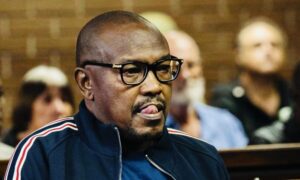
By Staff Writer: In a developing case that has drawn national attention, claims of judicial bias were aired this week before the Madlanga Commission of Inquiry in Johannesburg, casting a sharp light on the decision to grant bail to controversial businessman and murder-accused Katiso “KT” Molefe.
The allegations come as the commission continues to probe alleged collusion and corruption involving some of South Africa’s policing, prosecutorial, and judiciary networks.
Witness B, a detective with the SAPS Gauteng Organised Crime unit whose identity remains protected for safety and ongoing investigations, delivered testimony that she believes Ledwaba’s bail decision was premeditated.
The detective is assigned to the murder inquiry into Armand Swart, a Vereeniging-based engineer who was shot dead on April 17, 2025. Molefe is charged with Swart’s murder alongside three alleged hitmen: Warrant Officer Michael Pule Tau, Musa Kekana, and Tiego Floyd Mabusela.
Witness B described her discomfort with what she perceived as a courtroom outcome already being predetermined. “In June 2025, the matter was heard at the Gauteng North High Court in Pretoria, the presiding officer was the Acting Judge President Ledwaba.
During the hearing, I was very uncomfortable with what was transpiring; in particular, it felt to me that the Judge had already predetermined the matter. Although this is not uncommon, it seemed that he was intent on giving Mr Molefe, who is accused of very serious offences, lenient bail conditions,” she testified.
Two exchanges during the bail hearing, she said, stood out for their indicators of leniency. The first concerned movement-related conditions.
Molefe’s lawyer requested permission for movement within Gauteng or even house arrest, prompting Ledwaba to ask whether such limits would be too restrictive given Molefe’s business interests in other provinces.
The lawyer responded that Molefe engages in several business matters requiring travel, with travel plans to be communicated and written consent from the investigating officer sought, and not unreasonably withheld.
The second point involved Molefe’s family — his child and girlfriend living in KwaZulu-Natal — and how travel arrangements would be managed.
The lawyer stated that those relatives could visit Molefe, which the judge acknowledged, though he later commented that “bail should not be a punishment.” The final bail conditions allowed Molefe to travel after informing the investigating officer, with the officer able to object only for compelling reasons.
Witness B summarized her impression: Ledwaba’s line of questioning about whether the conditions were “too restrictive” suggested to her that leniency had already been factored in.
“The accused was the one applying for bail, and already placing on record what he was willing to accept, but the Judge felt this was ‘too restrictive’. I felt like the Judge showed too much leniency towards the accused, and that’s where I already knew that he (Molefe) was going to be granted bail already,” she said.
The detective noted that Molefe’s counsel accepted the routine condition that Molefe report to a police station, and she claimed the judge expressed the view that requiring such reporting would be a “burden” if the investigating officer was not always present. Molefe’s lawyer reportedly agreed to this stance.
Witness B added that the bail verdict seemed foregone to her, to the extent that she even considered withdrawing from the investigation. Her commanders declined to relieve her, and Molefe was released on bail.
In subsequent sessions, Witness A, a colleague of Witness B, testified that informants had warned of Molefe’s bail, including an alleged R2.5 million bribe intended to secure his freedom. These claims were described as red flags that might ordinarily have led to denying bail.
The narrative around Molefe’s prior history further complicates the case. He has a criminal record in the United Kingdom dating back to 2004 for possession of dagga and an illegal firearm, and he allegedly traveled using a fake passport under the alias David Teboho Lebetsa, with a different date of birth.
Witness B also highlighted the broader investigative environment surrounding Molefe’s arrest. She asserted that the Political Killings Task Team played a crucial role, citing “the high level of interference at the scene by other law enforcement units of the SAPS.”
Additional testimony alleged that a Johannesburg Metropolitan Police Department officer, Johannes Mokgatle, falsely reported sick to remain at Molefe’s residence during the arrest, a claim disputed by other law enforcement bodies involved whose operation was described as “bogus.”
A helicopter from the Gauteng Traffic Police was said to have hovered overhead during the operation, according to the testimony.
The Madlanga Commission of Inquiry was established to investigate allegations of collusion and corruption involving politicians, senior police officers, prosecutors, intelligence operatives, and elements of the judiciary.
The inquiry’s focus has broadened to include procedural fairness and potential leaks or undue influence encroaching on judicial independence.
The allegations originally surfaced in KwaZulu-Natal, when Provincial Police Commissioner Lieutenant General Nhlanhla Mkhwanazi brought issues to light in July 2025.