Subtotal R0,00

Politics/ 28 September 2025, 08:12am /Sipho Gumede
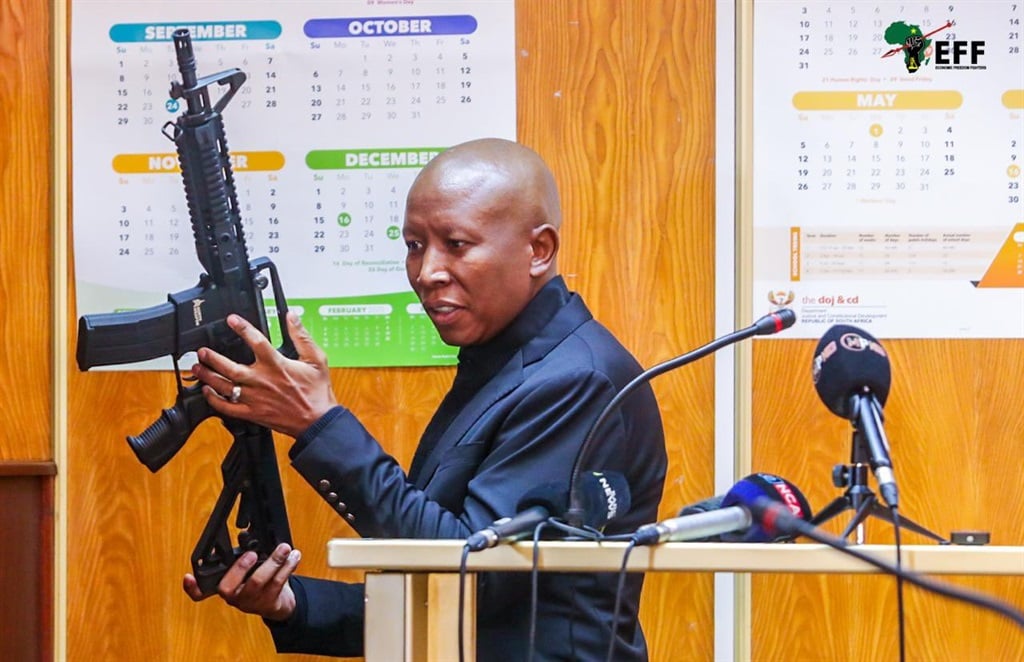
Julius Malema, the leader of the Economic Freedom Fighters (EFF): Image Supplied
By Sipho Gumede: The East London Magistrate’s Court is set to deliver judgment on Monday, 29 September 2025, in the high-profile criminal matter involving Julius Malema, the leader of the Economic Freedom Fighters (EFF). The charges arise from an incident at the party’s fifth anniversary celebrations at Sisa Dukashe Stadium in Mdantsane, Eastern Cape, in 2018, when Malema and his former bodyguard Adriaan Snyman faced allegations including unlawful possession of a firearm and ammunition, among other counts.
The lengthy proceedings have centered on a shooting incident during the 2018 celebrations. With the court poised to hand down its ruling, both defense and prosecution have presented competing interpretations of the evidence, notably surrounding a widely viewed viral video whose authenticity remains a point of contention for the defense.
Malema’s legal team, led by Advocate Laurence Hodes, SC, argues that the state has not proven its case beyond reasonable doubt. They contend that the viral video cannot be authenticated and that no witness has testified to seeing Malema fire a weapon. “There is no evidence linking the firearm to Mr Malema. The stage showed no signs of any physical damage, and no live rounds were recovered,” Hodes told the court. He noted that thousands attended the event, yet no eyewitnesses came forward, and no member of the SAPS VIP Protection Unit reported any untoward incident.
Advocate Shane Matthews, representing Snyman, pressed for acquittal on the grounds that the state had produced no evidence showing Snyman handed Malema a loaded gun or compromised public safety. “The State conceded that the rifle handover cannot be proven. There is no evidence that Snyman was in possession of a loaded firearm,” Matthews stated. He urged that Larry Mavundla, who signed out the rifle later linked to cartridges found at the stadium, should have been questioned, emphasizing that “He was present in East London, at the stadium, on stage. I fail to understand why the State did not engage him.”
The defense also scrutinized the use of the viral video, arguing that steps to verify its authenticity were inadequate. Matthews underscored concerns about digital evidence by recounting an unrelated observation: he referenced a video he had seen of Magistrate Twanette Olivier dancing on the EFF stage to illustrate the perils of unauthenticated content.
Prosecutor Joel Cesar countered with a different view of the evidence. He pressed that spent cartridges found at the stadium two days after the event were linked to Snyman’s company, with four cartridges matching a spent case found, and that the rifle associated with those cartridges bore altered parts. He rejected the defense’s authenticity concerns, stating, “The defence never proved the video was edited or doctored. The evidence before the court is real.” Cesar noted that Malema testified he had handed the firearm to Mavundla and that the cartridges were discovered near a stage that had been cleared the day after the event, adding, “There was no other major event in between.”
Describing the video as “the best silent witness,” Cesar asserted that seven people were seen moving away when Malema allegedly fired in their direction, countering the defense’s assertion that no one reacted. The defense, however, has emphasized gaps in the chain of evidence and challenged the reliability of the video.
Malema voiced his concerns about the delay, suggesting it signaled bias and political maneuvering. He argued that the delay reflects a political trial and asserted that the arguments presented in court were filed long before, in December. “In a normal Magistrate’s Court, the magistrate would have passed judgment and sent reasons later. These arguments were submitted in December,” he said. “You can see clearly it’s a political trial. They will now decide which direction they want to go.”
Malema also criticized the state’s approach to Snyman’s case, claiming there was no evidence tying Snyman to wrongdoing. He contended that the prosecutor, whom he described as “in his fake 50 years of experience,” was unable to declare Snyman innocent and instead pursued other charges. “The case has crumbled. The prosecution must take responsibility,” he concluded.