Subtotal R0,00

Free State/ 22 August 2025, 08:41am/Mpho Mokoena
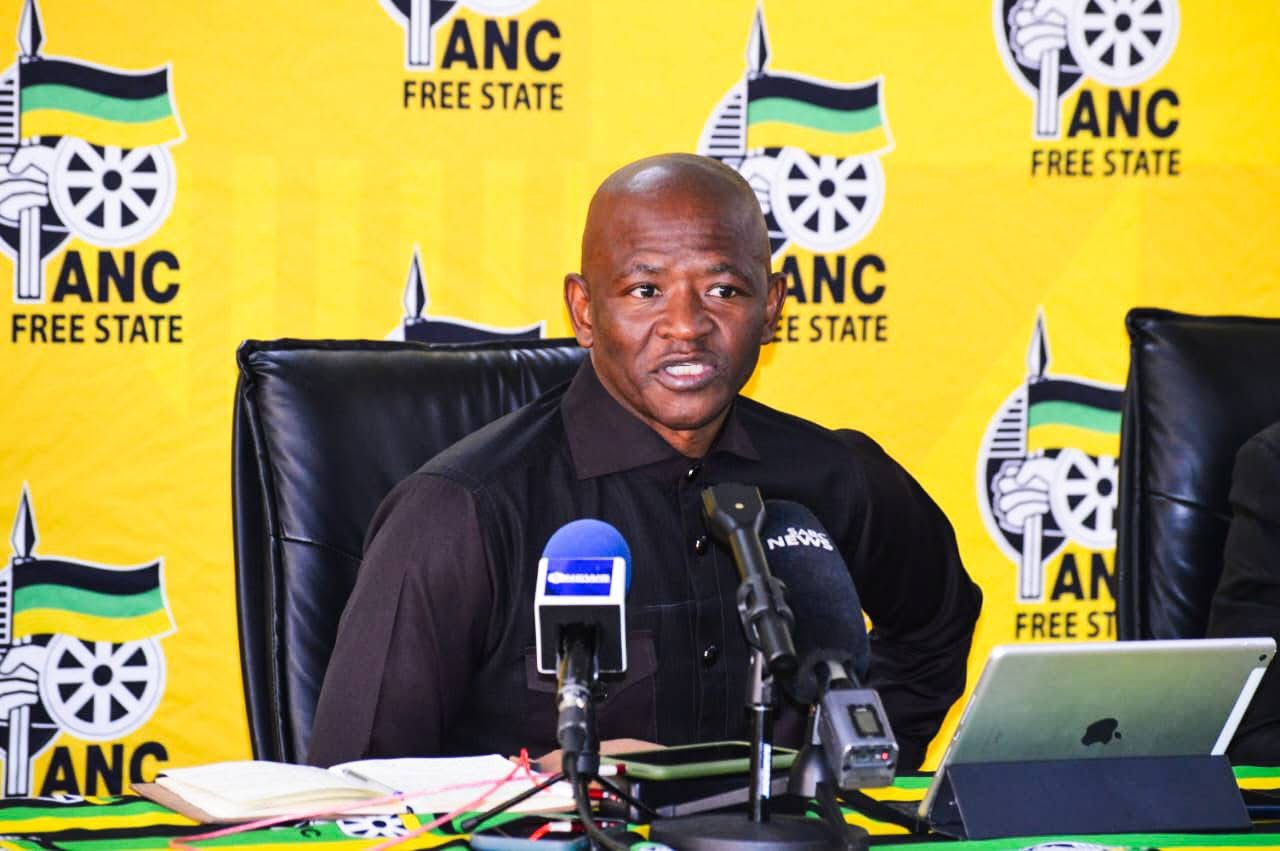
ANC provincial secretary Polediso Motsoeneng: Image Supplied
By Mpho Mokoena: The African National Congress (ANC) in the Free State has announced a sweeping intervention aimed at halting a drift toward organisational decay blamed on leadership failures, sins of incumbency, and weak consequence management. The plan was laid out in a comprehensive briefing to the party’s Provincial Executive Committee (PEC), which signalled that restoring credibility and delivering on its mandate demands a triple focus: resilient, courageous, and principled leadership; a committed, conscious cadreship with active civil society mobilised; and a renewal framework that realigns the movement with its democratic mandate and the needs of the people.
A detailed document presenting the PEC’s deliberations from its August 11 meeting painted a stark portrait of what the party calls the political price of neglect in governance. It argues that the electoral setbacks of 2024 — at both provincial and national levels — were not simply the fault of a rising opposition but a reflection of the movement’s own record, its alliance dynamics, and its performance in government.
Three conditions sit at the heart of the renewed strategy. First, a leadership corps described as resilient, courageous, and principled, capable of making tough decisions even when political winds blow hard. Second, a consciously mobilised cadreship together with an engaged civil society, ready to stand with the movement and hold it to account. Third, a renewal framework that aligns the party’s action with its democratic-mandate obligations and the realities on the ground in communities across the Free State.
Officials describe the renewal as part of a larger amalgamation of factors informing the province’s governance trajectory. The aim is to reimagine how governance is done, strengthen accountability, and ensure that the movement’s promises translate into reliable public services. The officials stress that the path to this renewal requires relentless self-reflection about the party’s electoral defeats and a clear-eyed assessment of its alliances and governance record.
The PEC’s public account of the renewal process includes a sequence of decisive steps and interventions designed to rebuild the party’s organisational spine and its connection to the people. In recent weeks, the leadership traversed the province to re-establish and fortify branches where they were non-existent or had lapsed, ensuring there are legitimate structures ready to execute the ANC’s political work and to deepen the connect with communities on the ground.
On the electoral front, the PEC reviewed preparations for the Nala Municipality by-elections, reporting positive indications for victory and confirming alignment with the Lejweleputswa regional election team. Roadmaps were outlined for upcoming regional conferences in Mangaung and Lejweleputswa, with administrative processes in motion and deployees instructed to provide robust support to ensure successful convenings later this year.
The meeting also touched on a sensitive matter in Maluti-a-Phofung, where Councillor Mary Crocket has faced legal challenges. The PEC acknowledged her voluntary step aside in line with the ANC’s internal “step aside” rule, signalling the party’s willingness to enforce its own discipline in challenging circumstances.
Alliance dynamics featured prominently in discussions following the National Executive Committee’s report, particularly the need to strengthen ties with SAMWU and SANCO and to streamline the Alliance Secretariat in view of an upcoming Alliance Summit. Strengthening collaboration with alliance partners was identified as essential to delivering coherent governance and service delivery.
Attention to governance at both provincial and local levels dominated the agenda, with lessons from the PEC Roadshow and the Joint Portfolio Committee on Local Government visit informing the urgency of reform. The PEC authorised urgent interventions in several municipalities—Mafube, Moqhaka, Letsemeng, Nketoana, Nala, and the Lejweleputswa District—due to persistent governance weaknesses, leadership gaps, and allegations of corruption. Redeployments were approved, and actions by the provincial CoGTA were expected in confirmed cases of malfeasance, with senior management positions (Section 56/57) to be filled by end-2025 with qualified professionals.
Monitoring, evaluation, and oversight mechanisms received a sharpened mandate. The party’s War Room and related oversight bodies would be enhanced to track the implementation of ANC resolutions, government programmes, and unfinished infrastructure projects, ensuring accountability translates into real-world progress.
The PEC urged deployees at both provincial and local levels to align with core commitments from the 2021 and 2024 manifestos, the January 8 Statement priorities, and Lekgotla injunctions. Specific attention was drawn to water-related issues and the Ngwathe court case, with a commitment to engage constructively with national and provincial interventions, including the National Intervention on Local Government and SALGA, to chart a pragmatic path forward.
A central pillar of the renewed ethic centers on accountability and ethical leadership. The party declared that true transformation begins with a refreshed, responsive, well-governed, well-resourced political formation rooted in integrity. The leaders emphasised that unlearning past missteps is par
The Free State ANC also signalled a bold, governance-focused intervention in seven struggling municipalities, after reviewing persistent governance failures, financial irregularities and allegations of corruption. The dramatic move was announced on Thursday, following a special sitting of the provincial executive committee (PEC) in Mangaung, and affects Mafube, Moqhaka, Letsemeng, Nketoana, Nala, Masilonyana and the Lejweleputswa District.
ANC provincial secretary Polediso Motsoeneng said the reshuffle was part of a wider intervention to stabilise municipalities plagued by persistent audit disclaimers, weak leadership and poor service delivery. “Communities have endured years of poor governance and allegations of corruption. The ANC has a responsibility to act decisively to restore credibility and ensure basic services reach our people,” Motsoeneng told the media.
Local government in the Free State has long been under scrutiny for collapsing infrastructure, mismanagement of public funds and widespread political infighting. Many of the municipalities affected by the latest reshuffle have been the subject of repeated interventions by the provincial and national governments. Mafube Local Municipality, which includes Frankfort, has been under administration since 2017 and is notorious for financial mismanagement and unpaid Eskom debt. Moqhaka, which covers Kroonstad, has faced mounting community protests over water shortages, sewage spills and pothole-ridden roads. Lejweleputswa District has drawn criticism for failing to coordinate development across the mining towns of Welkom, Virginia and Odendaalsrus.
Motsoeneng conceded that municipal leadership failures had compounded administrative weaknesses: “The Troika, mayors, speakers and chief whips are meant to provide political oversight and direction. Where they have failed, service delivery has collapsed. Our decision is not about targeting individuals, but about collective renewal and accountability,” he said.
A PEC report flagged corruption allegations as a recurring issue in several of the affected municipalities. In Letsemeng, where the ANC narrowly held onto control in the 2021 local government elections, councillors have faced accusations of irregular tender awards. In Masilonyana in Theunissen, residents have for years complained of “tenderpreneurs” siphoning funds meant for water and sanitation projects. While Motsoeneng did not name individual councillors implicated in wrongdoing, he confirmed that the PEC had directed provincial structures to cooperate with formal investigations, including the use of Section 106 of the Municipal Systems Act, which allows the provincial government to probe maladministration and fraud.
The ANC’s move comes less than a year after President Cyril Ramaphosa warned during the January 8th statement that the party risked losing public trust unless it dealt with corruption and incompetence in local government. With the 2026 municipal elections looming, the Free State leadership is under pressure to demonstrate renewal. Motsoeneng linked the reshuffle to the ANC’s broader “renewal project,” which seeks to strengthen governance, deliver on election manifesto commitments and reconnect with disillusioned voters. “The ANC is taking a hard but necessary path. Renewal means unlearning bad practices, restoring ethical leadership and focusing on urgent community needs such as water, electricity, road maintenance, job creation and support for township economies. We cannot go into 2026 carrying the same mistakes of the past,” he said.
The PEC discussed relations with alliance partners, including the South African Municipal Workers Union and the SA National Civic Organisation, both of whom have raised alarms about collapsing service delivery in small towns. The provincial leadership committed to strengthening alliance forums at regional and local level to ensure accountability and better communication with communities. Motsoeneng further revealed that a “war room” for monitoring and evaluation would be established to track service delivery progress and assess the performance of newly appointed municipal leadership.
The ANC insists its latest intervention marks a turning point, describing its aim as restoring trust and putting municipalities back on a path of stability, accountability and service to the people. The provincial working committee is expected to announce replacement mayors, speakers and chief whips in the coming weeks.