Subtotal R0,00

Education/ 14 April 2025, 14:00pm/ Staff Writer
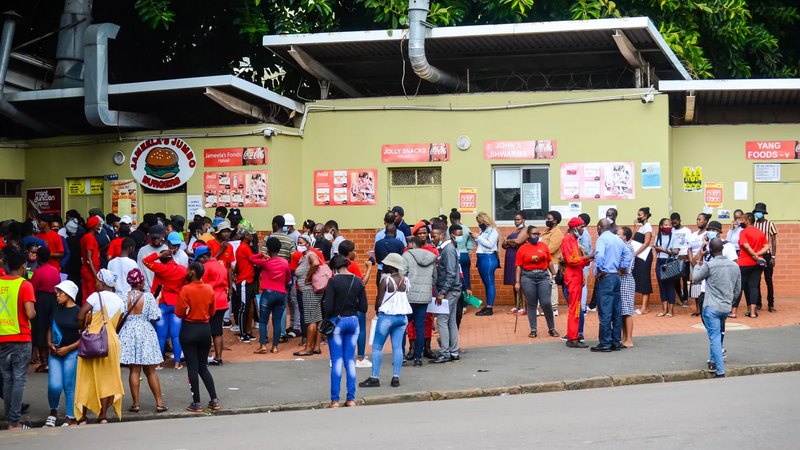
DUT students affiliated with the EFF and SASCO protested against NSFAS in KZN outside the Steve Biko Campus: Image Supplied
By Staff Writer: Rogue societal elements are exploiting the expectations created by South Africa’s fee-free higher education policy, leading to recurring student protests that disrupt academic progress and threaten the integrity of the country’s universities, warned Professor Thandwa Mthembu, Vice-Chancellor and Principal of the Durban University of Technology (DUT).
Delivering the State of the University Address last week, Mthembu said the culture of violent and disruptive protests has become entrenched in the post-school education sector. He blamed opportunistic individuals for taking advantage of student frustrations to push agendas that go beyond genuine educational concerns.
“Expectations remain that universities must cater to the entire welfare needs of students, including accommodation for every NSFAS-funded student,” he said. “These expectations are being exploited by rogue societal elements to legitimise annual student protests, which often force institutions to suspend academic activity for weeks.”
Mthembu warned that these actions undermine both the quality of education and the values universities strive to uphold. Despite regular engagement between university management and elected student representative councils, he said some groups are more interested in fueling unrest than finding solutions.
He traced the roots of this tension to the unexpected 2017 announcement by then-President Jacob Zuma that higher education would be free. The timing of the announcement—made just after DUT had finalised its annual budget—left many institutions unprepared for the consequences.
“We cautioned then that there would be major negative ramifications of that decision,” Mthembu said.
Although he acknowledged the policy’s good intentions in expanding access to students from disadvantaged backgrounds, he stressed that its rushed rollout created confusion and unrealistic expectations. “It spawned behaviour among some young people who felt universities should overlook entry requirements simply because higher education was ‘free,’” he added.
Universities are also expected to adhere to strict enrolment quotas set by the Department of Higher Education and Training, and failure to meet these targets—whether by over- or under-enrolment—comes with financial penalties. This makes long-term planning, particularly with NSFAS, both critical and complex.
Mthembu said the cost of continuous protest goes beyond disrupted calendars. “Loss of teaching and learning time affects the minimum notional hours needed to achieve educational outcomes,” he explained. “And while departments often draw up catch-up plans, the quality of teaching and assessment inevitably suffers.”
He raised concern about the long-term consequences of this environment. “It would be foolhardy to dismiss suggestions that, with so much less time to do everything, the quality of teaching and learning has been compromised—sometimes beyond repair,” Mthembu said. “We cannot ignore the growing concern over not just unemployed, but unemployable graduates.”
He also pointed to internal issues at DUT, including network and Wi-Fi challenges, but said these are being addressed. “Unfortunately, the sheer volume of work in certain areas means some progress will take time,” he said.
However, Mthembu drew a line when it came to the destructive tactics of protest groups. “Does that warrant destruction of property, acts of intimidation and violence meted out to staff and students and the university infrastructure? There is no justification for these ugly and repulsive behaviours.”
Although violent incidents at DUT have decreased, he said the national protest culture still poses a risk. “Living in a South Africa that has nationalised the sub-culture of violent protest, it is difficult for DUT to be a protest and violence-free oasis.”